When I work with small business owners, the Section 199A deduction often starts as a simple question: “Do I get 20 percent off my business income?” Then tax time hits and they realize they also own REITs in a brokerage account, or they bought a publicly traded partnership because the yield looked great.
Here is the key idea that clears up most confusion: qualified REIT dividends and qualified publicly traded partnership (PTP) income can generate their own 199A deduction, but they sit in a separate bucket from the qualified business income (QBI) coming from your operating company.

The two 199A buckets
Section 199A is commonly called the QBI deduction, but the statute effectively gives you multiple ways to compute a potential 20 percent deduction depending on the type of income.
Bucket 1: QBI from your own business
This is the portion most business owners know. If you own a pass-through business such as an S corporation, partnership, or sole proprietorship, you may be eligible for a deduction of up to 20 percent of your qualified business income from that trade or business.
This bucket is the one with the famous limitations: taxable-income thresholds, W-2 wage and qualified property limits, and special rules for specified service trades or businesses.
Bucket 2: Qualified REIT dividends and qualified PTP income
This is the part many investors miss. Qualified REIT dividends and qualified PTP income can also produce a 199A deduction. In many cases, the starting point is 20 percent of the qualifying amount, but the final deduction can still be reduced by the overall Section 199A limits discussed below.
Important differences:
- It is not QBI from your business. You do not “mix” REIT/PTP amounts into your company’s QBI calculation.
- The W-2 wage and qualified property limits apply to the QBI component. The REIT/PTP component is computed separately, so it is not reduced by those QBI wage/property limits in the same way.
- You still need the right reporting inputs. REIT amounts typically flow from Form 1099-DIV, while PTP amounts come from the K-1 package.
- It still interacts with your overall taxable income. Your total 199A deduction is limited by your taxable income (more on this below).
What counts as qualified REIT dividends?
Not every distribution tied to real estate is automatically treated the same way for 199A.
Qualified REIT dividends generally include:
- Ordinary REIT dividends reported to you as Section 199A dividends. For most investors, this is shown on Form 1099-DIV, Box 5 (Section 199A dividends).
- REIT dividends received through mutual funds or ETFs, to the extent the fund reports Section 199A dividends to you (again, commonly reflected in Box 5 of your 1099-DIV).
Common items that are often not qualified REIT dividends for this purpose:
- Capital gain distributions (reported as capital gain distributions, not Section 199A dividends).
- Return of capital (often reported in Box 3 on Form 1099-DIV). This can affect your basis, but it is not the same as Section 199A dividends.
- Qualified dividend income (QDI) from regular corporations. QDI may get favorable capital gains tax rates, but it is a separate concept from 199A.
- Amounts not reported as Section 199A dividends on your tax forms.
If you are an everyday investor, your practical takeaway is this: pull your 1099-DIV and look at Box 5. That is the number that typically drives the REIT dividend portion of the 199A calculation.

What counts as qualified PTP income?
A publicly traded partnership is generally a partnership whose interests trade on an established securities market. Many investors encounter them through certain energy, infrastructure, and natural resource businesses.
In the real world, most PTPs issue Schedules K-1. The “I thought this was just a high-yield stock” moment usually happens when someone buys a PTP in a brokerage account and later learns a K-1 is coming, often on a different timeline than a 1099.
Qualified PTP income for 199A is generally the portion of items from the PTP that are treated as qualified items for the deduction under the 199A rules, as reported to you via the K-1 and any attached statements that include 199A data.
Two practical notes I give clients:
- Do not assume the cash distribution equals qualified PTP income. Partnerships can distribute cash even when taxable income is low or negative, and vice versa.
- Expect the 199A detail to come from the K-1 package. Many tax software programs will prompt for 199A-related PTP fields after you enter the K-1 inputs and statement codes.

How it shows up on your return
Most taxpayers do not hand-calculate Section 199A from scratch, but it helps to understand the flow so you can sanity-check what your software or preparer is doing.
One deduction, separate components
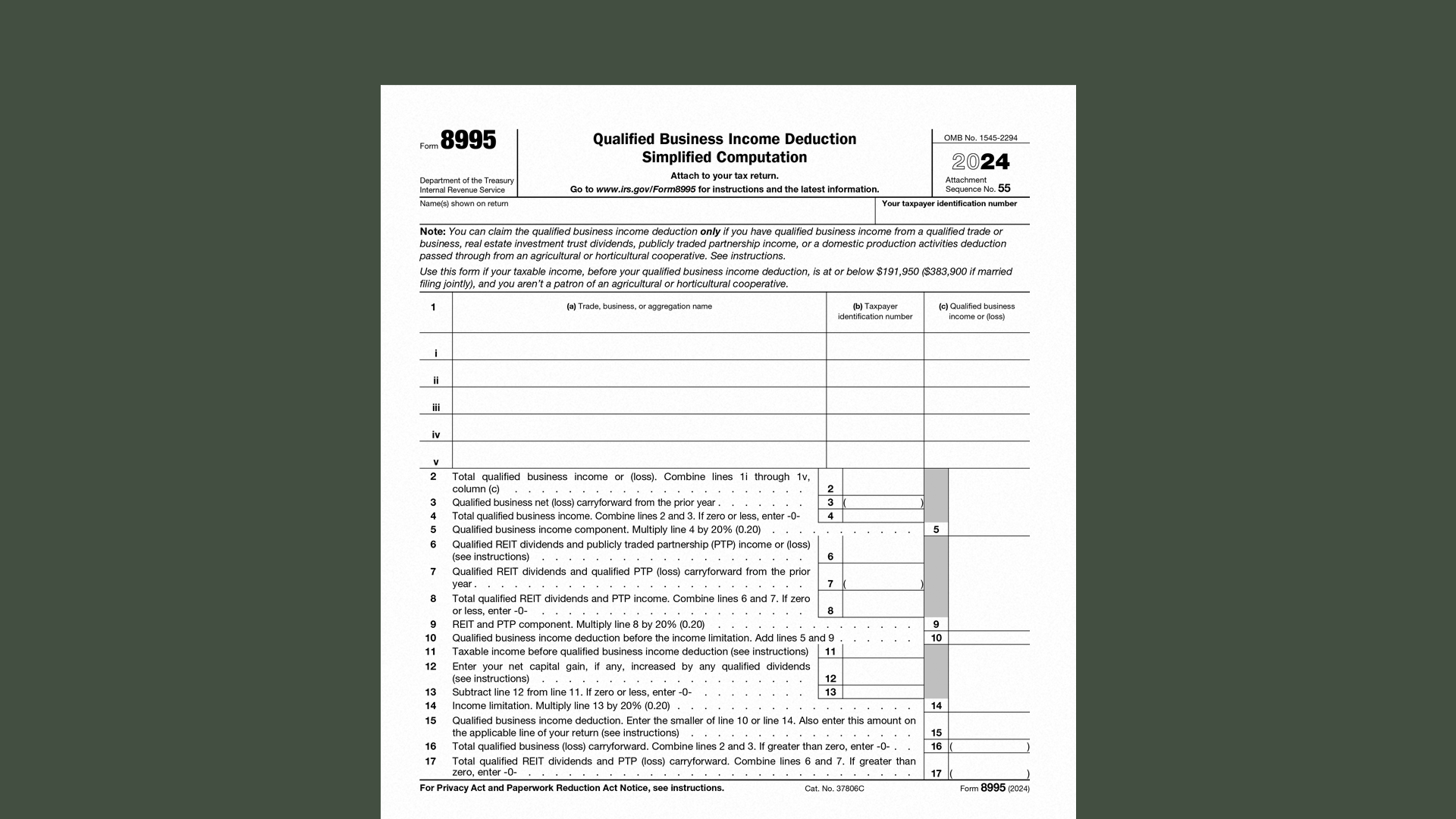
In broad strokes, your total Section 199A deduction often looks like:
- 20% of QBI from your operating business (subject to various limits), plus
- 20% of qualified REIT dividends and qualified PTP income (a separate component),
- then potentially reduced by an overall cap based on your taxable income.
That “separate component” language is not just semantics. It is why someone can have their business QBI deduction reduced due to wage and property limits, but still receive a meaningful 199A benefit from Section 199A dividends reported on a brokerage 1099.
If you have ever seen Form 8995 or Form 8995-A in your tax return package, those are common forms used to compute and report the Section 199A deduction (depending on complexity and income level).
The overall cap to watch
Even with clean inputs, Section 199A is not allowed to exceed 20 percent of your taxable income minus net capital gain (simplified wording, but directionally right). This matters when:
- You have large qualified dividends or long-term capital gains.
- Your taxable income is relatively low after deductions.
- You have a year with a business loss or big itemized deductions.
Walkthrough: business plus REIT dividends
Let’s walk through the scenario I see constantly: a founder has operating income from their pass-through business and also owns REITs in a taxable brokerage account.
Step 1: Separate your income streams
- Business stream: Net profit from Schedule C, or ordinary business income from an S corporation or partnership K-1. This is where QBI comes from.
- Investor stream: Section 199A dividends reported on Form 1099-DIV (often driven by REIT holdings and certain funds). These are not QBI, but they can still produce a 199A component.
Step 2: Compute business QBI
Your business QBI deduction depends on the usual factors: taxable income level, whether the business is an SSTB, W-2 wages paid, and qualified property. None of those facts are determined by your REIT holdings. They are business facts.
Step 3: Compute the REIT component
If your 1099-DIV reports $X of Section 199A dividends (Box 5), the starting point is generally 20 percent of $X.
Step 4: Apply the overall taxable-income limit
Now the two components come back together under the umbrella of the overall 199A limit tied to taxable income (minus net capital gain). If your taxable income is not high enough to support the full combined deduction, your allowed 199A deduction can be reduced.
A simplified example
Imagine a taxpayer with:
- $120,000 of QBI from a consulting business
- $10,000 of Section 199A dividends on 1099-DIV Box 5 (for example, from REIT holdings)
Ignoring income thresholds, wage/property limits, and the taxable-income-minus-net-capital-gain cap for the moment:
- Potential QBI deduction: 20% × $120,000 = $24,000
- Potential REIT component: 20% × $10,000 = $2,000
- Total potential 199A deduction: $26,000
Then you check the overall taxable-income limitation. That is often the step that explains why the final number is lower than the “20 percent times everything” mental math.
Practical takeaway: You can benefit from 199A in two ways in the same year, but the math is only additive after you compute each component correctly and run the overall limitation.
Common pitfalls
Mistake 1: Treating REIT dividends as business QBI
If you run an LLC and also hold REITs, it is tempting to think of everything as “business income.” For 199A purposes, REIT dividends generally do not go into the same QBI bucket as your company’s operating profit. They are handled as their own component when they show up as Section 199A dividends.
Mistake 2: Confusing REIT dividends with rental real estate you own
Owning a rental property in your own name or LLC can potentially create QBI if it rises to the level of a trade or business under the relevant rules. Owning a REIT is different. A REIT dividend is investment income that can qualify for its own 199A component when properly reported.
Mistake 3: Assuming all high-yield products qualify
Preferred stock dividends, bond interest, and money market interest do not become 199A-eligible just because the yield is high. For the REIT/PTP component, the income needs to be specifically qualified and reported accordingly.
Mistake 4: Forgetting account type
This one surprises people. If your REITs or PTP exposure is held inside a traditional IRA, Roth IRA, or 401(k), you typically do not get a current 199A deduction on your individual return because the income is not currently taxable to you in the same way.
Mistake 5: Overlooking PTPs in IRAs
Separate from 199A, holding a PTP in an IRA can create potential UBTI (and sometimes UBIT) issues. If you bought the PTP for the yield and parked it in a retirement account, it is worth asking your advisor or tax pro whether UBTI is in play.
Mistake 6: Ignoring state taxes
Section 199A is a federal deduction. Many states do not conform fully, or they treat pass-through deductions differently. Your federal benefit may not carry over on the state side.
FAQ
Do REIT dividends count as QBI?
Generally, no. REIT dividends are not QBI from your own trade or business. However, Section 199A dividends can still qualify for their own separate 20 percent 199A component when properly reported (commonly via 1099-DIV Box 5).
Do REIT dividends reduce my business QBI deduction?
Not directly. They are computed separately. The main interaction is through your overall taxable income limitation, which can cap the total 199A deduction you are allowed to claim.
What if my REIT payment is labeled a capital gain distribution or return of capital?
Capital gain distributions are generally treated as capital gains, not as Section 199A dividends. Return of capital (often 1099-DIV Box 3) is also not Section 199A dividends. Your 1099-DIV classification is your best starting point.
I bought a PTP and got a K-1. Is all of it eligible for 199A?
Not necessarily. The eligible amount is typically the portion identified as qualified PTP income under the 199A rules, based on K-1 inputs and supporting statements. Cash distributions and taxable income are not the same thing in partnership taxation.
Can I get a 199A deduction if my business has a loss?
A business loss can reduce or eliminate QBI for the year. Under the 199A netting rules, negative QBI from one qualified business can offset positive QBI from another, and any remaining negative amount can carry forward for 199A purposes. You might still have a REIT/PTP component if you have Section 199A dividends or qualified PTP income, but the overall limitation calculations still control the final outcome.
Quick filing checklist
- Pull your 1099-DIV and identify the amount in Box 5 (Section 199A dividends).
- If you own PTPs, gather every K-1 and any attached statements that reference Section 199A.
- Keep your business QBI inputs clean, including wages, basis in qualified property (if relevant), and whether your activity is an SSTB.
- Check the final limitation based on taxable income minus net capital gain.
- Ask your tax pro a direct question: “Are you calculating the REIT/PTP 199A component separately from my business QBI, and are you applying the overall taxable-income limit?”
If you understand the “two buckets” concept, you are already ahead of most filers. It is the simplest way to make sure you do not leave a deduction on the table, or accidentally claim it in the wrong place.