One of the most frustrating surprises I see with the Qualified Business Income deduction is this: you have a profitable year, you do everything “right,” and your QBI deduction is smaller than expected or flat-out zero.
Often, the reason is a prior-year QBI loss carryforward.
If you had negative qualified business income in a past year, the tax code does not let you ignore it when you swing back to profit. That negative amount carries forward and reduces the QBI you can use to calculate this year’s Section 199A deduction.

What the carryforward does
When your business has a net loss for QBI purposes, the IRS treats it as a negative QBI amount. You do not get a negative deduction. Instead, that negative amount becomes a carryforward that must be applied against QBI in the next year you have positive QBI.
In plain English: you have to earn your way out of last year’s QBI loss before you can claim a QBI deduction again.
Two key points
- The carryforward offsets QBI, not your whole taxable income. You can have a healthy W-2 job, investment income, or other household income and still have your QBI deduction reduced because last year’s business results were negative.
- It is computed after netting for the year. If you have multiple qualified trades or businesses, QBI losses from one can offset QBI income from another in the same year. The “negative QBI carryforward” is what is left after that annual netting is done.
A simple Schedule C example
Let’s walk through a clean example for a sole proprietor filing Schedule C. I’m keeping the math focused on the carryforward so you can see the mechanism clearly.
Assumption: There are no adjustments between Schedule C net profit (loss) and QBI for these examples (in real life, QBI can differ).
Year 1: Loss year
- Schedule C net profit (loss): ($20,000)
- Assume this loss is also the taxpayer’s negative QBI for the year
- Result: No QBI deduction in Year 1
- Carryforward to Year 2: $20,000 negative QBI
Year 2: Profit year
- Schedule C net profit: $60,000
- Current-year QBI before carryforward: $60,000
- Apply prior-year negative QBI carryforward: $60,000 - $20,000 = $40,000
- Net QBI eligible for the deduction this year: $40,000
Now the familiar profit-year concept kicks in: the QBI deduction is generally 20% of net QBI, but it can still be limited by other rules.
Ignoring other limitations for simplicity:
- QBI deduction in Year 2: 20% x $40,000 = $8,000
Without the carryforward, many people would expect:
- 20% x $60,000 = $12,000
That gap, $4,000, is the echo of the prior-year loss showing up in a year that otherwise looks great on paper.

When profit is not enough
If your current-year profit does not fully absorb the prior negative QBI, you still do not get a QBI deduction, and the remaining negative amount continues forward.
Example:
- Prior-year negative QBI carryforward: $20,000
- Current-year QBI (profit year): $12,000
- Net QBI after carryforward: $12,000 - $20,000 = ($8,000)
- QBI deduction this year: $0
- Carryforward to next year: $8,000 negative QBI
This is why a business can be back in the black and still have no QBI deduction for a while, especially after a tough year.
Where it shows up on the return
In the real world, a prior-year QBI loss carryforward is one of the issues that can complicate the Section 199A calculation and the forms used to report it.
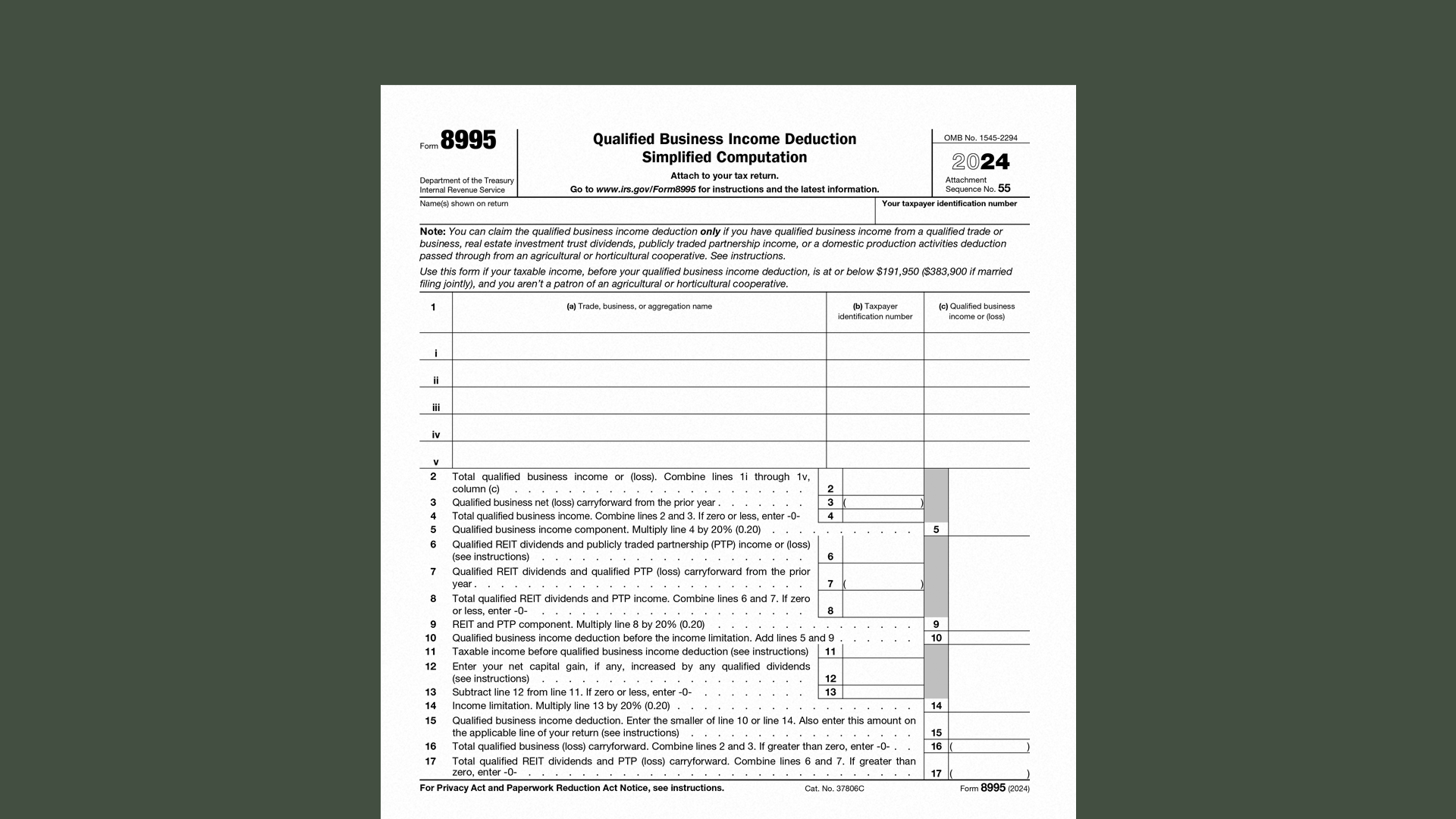
You will typically see the deduction computed on Form 8995 (the simplified form) or Form 8995-A (the more detailed form). Depending on the year’s IRS instructions and your overall facts, a carryforward may push you into the more detailed computation so the loss netting and carryforward are properly tracked.
If you want the baseline profit-year QBI mechanics, start with our main explainer: Qualified Business Income Deduction Explained. This page is the add-on for what changes once a prior-year loss exists.
Other limits still matter
Even after you absorb a carryforward, the deduction is not always a clean 20% of what is left.
- Taxable income limit: The deduction is capped at 20% of your taxable income (minus net capital gains). So a carryforward can reduce QBI, and the taxable-income cap can reduce the deduction further.
- Higher-income limits: Once your taxable income gets above the IRS thresholds for the year, additional restrictions can kick in, including W-2 wage and UBIA limits, and special rules for specified service trades or businesses (SSTBs).
I am not turning this page into a phaseout chart, but I do not want you to assume “carryforward absorbed” automatically means “full 20% deduction allowed.”
Common misunderstandings
My business loss already reduced my taxable income last year. Why does it reduce this deduction too?
Because the QBI deduction is designed as a benefit tied to net qualified business income over time, not just the current year in isolation. A prior negative QBI year reduces the pool of QBI that can generate a deduction in later years.
Is this the same as an NOL carryforward?
No. A net operating loss (NOL) has its own rules and its own carryforward calculation. A QBI loss carryforward is specific to the Section 199A deduction and applies against later QBI, not against all income categories.
Do I lose the carryforward if I change business types?
Not necessarily, but it can get messy quickly because QBI is calculated at the trade or business level and interacts with items like multiple businesses, pass-through entities, and aggregation elections. If you are restructuring, merging activities, or adding a new entity, it is worth running the QBI numbers intentionally before year-end.
Practical moves
- Plan for a smaller deduction in the first profitable year after a loss. Build that into your estimated tax payments so you are not caught off guard.
- Keep clean bookkeeping around year-end. QBI starts with business income, but some items that show up in your business return do not count the same way for QBI purposes.
- Be careful with one-time write-offs. Aggressive deductions that create or deepen a QBI loss can be perfectly legitimate, but they can also push your QBI benefit into future years.
- Coordinate across businesses. If you have multiple activities, profits from one can be reduced by losses from another when QBI is netted for the year. That ordering and netting can change what gets carried forward.
FAQ
How long does a QBI loss carryforward last?
It carries forward until it is absorbed by later positive QBI. There is no simple “expires after X years” rule. Practically, it stays relevant as long as Section 199A remains available and you have future QBI to use it.
Does a QBI carryforward reduce last year’s deduction retroactively?
No. The carryforward is created in the loss year and applied going forward. It reduces the QBI available to generate a deduction in later years.
If I have a profitable year, will I automatically get a QBI deduction?
Not automatically. A prior-year QBI loss carryforward can reduce current-year QBI to zero. Other limitations can also apply depending on your taxable income and business characteristics.
Bottom line
A prior-year QBI loss carryforward is one of those tax rules that feels unfair until you see the logic: the QBI deduction is meant to reward net qualified business income, and the IRS makes you net losses and gains across years.
If you are returning to profit after a rough year, take a minute to ask, “Do I have any negative QBI carryforward?” It is often the difference between expecting a 20% deduction and getting a much smaller number.