Yes, you can absolutely claim the Qualified Business Income (QBI) deduction even if you take the standard deduction.
This is one of those tax myths that refuses to die because the QBI deduction sounds like a classic write-off. But it is not an itemized deduction like mortgage interest or charitable gifts. It is a separate deduction that shows up after you calculate your adjusted gross income (AGI), and it can be taken whether you itemize or not.
QBI is not itemized
The QBI deduction, also called the Section 199A deduction, is generally worth up to 20% of your qualified business income from eligible pass-through business activity (like a sole proprietorship reported on Schedule C, many partnerships, and many S corporations).
Here is the key structural point:
- Standard deduction vs itemized deductions is a choice you make to reduce your taxable income.
- QBI deduction is a separate deduction that also reduces your taxable income, and it is allowed in addition to either the standard deduction or itemized deductions.
So the question is not “standard deduction or QBI?” It is “standard deduction or itemize?” and then, separately, “do I qualify for QBI?”
Where QBI shows up
If you have ever wondered why QBI feels a little hidden, it is because it does not reduce your AGI.
Think in three layers
- Business profit and other income flows into your total income.
- Adjustments (like deductible IRA contributions, student loan interest, and the self-employed health insurance deduction) can reduce income to arrive at AGI.
- Then you subtract either the standard deduction or itemized deductions, and after that you subtract the QBI deduction to arrive at taxable income.
In other words: QBI comes after AGI. It is not “above the line.”
One more common point of confusion: QBI affects your income tax calculation. It does not reduce self-employment tax, which is figured separately.

Example with standard deduction
Let’s use an intentionally simple example to show the ordering and one important limit that surprises people.
Scenario: Maya is a graphic designer who files as a sole proprietor (Schedule C). She does not itemize, so she takes the standard deduction. Her taxable income is below the annual threshold for her filing status in the relevant tax year, so the wage and property limits and the specified service trade or business (SSTB) phaseout rules are not limiting her QBI deduction. (Because thresholds change by year and the QBI rules can change with future tax law, it is always worth checking the current-year numbers.)
Maya’s numbers (simplified)
- Schedule C net profit (qualified business income): $80,000
- Other income: $0
- Adjustments to income: $0 (to keep the math clean)
- Filing status: Single
- Standard deduction: $14,600
Step 1: Calculate AGI
AGI = $80,000
Notice what is not happening: QBI is not reducing AGI.
Step 2: Subtract the standard deduction
$80,000 − $14,600 = $65,400
At this point, $65,400 is Maya’s taxable income before the QBI deduction.
Step 3: Compute QBI and apply key limits
Under the basic rule, the QBI deduction starts as up to 20% of qualified business income, and is then subject to several limits.
20% × $80,000 = $16,000
But there is a second limiter that often matters, especially when you have a large standard deduction (or itemized deductions): your QBI deduction is capped at 20% of your taxable income (minus net capital gains, if any).
Maya has no net capital gains in this simplified example, so the cap is:
20% × $65,400 = $13,080
Because $13,080 is less than $16,000, Maya’s QBI deduction is limited to $13,080.
Step 4: Subtract the allowed QBI deduction
$65,400 − $13,080 = $52,320 taxable income
This is the punchline: Maya used the standard deduction and still got the QBI deduction. They stack. The standard deduction did not disqualify her. It just helped push down taxable income, which can also reduce the maximum QBI allowed in some cases.
Which form you use
Your choice to itemize or take the standard deduction does not decide which QBI form you use. The form depends on your QBI details for the year, including whether you are under the taxable-income threshold and whether you have items like REIT dividends or publicly traded partnership income.
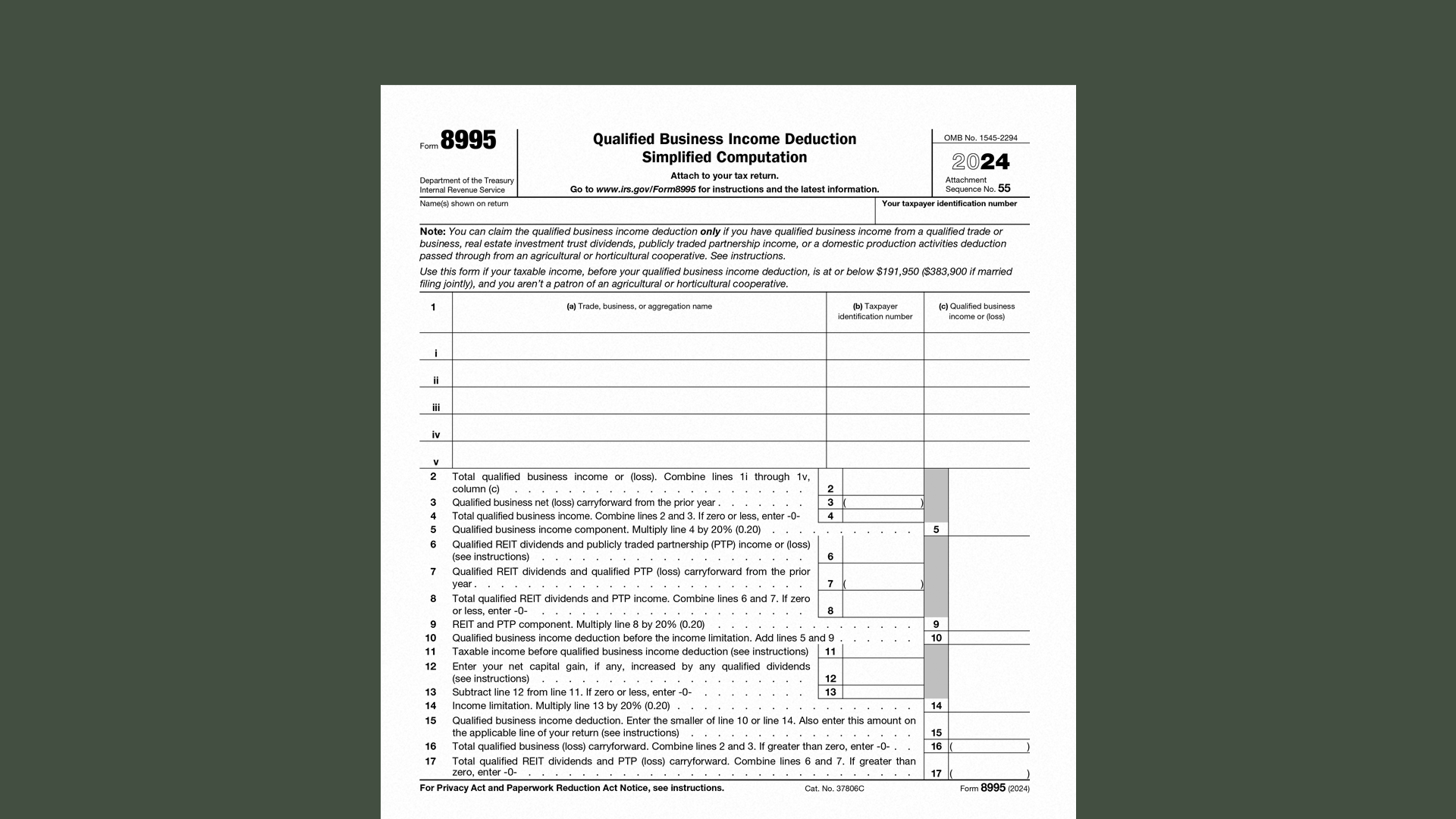
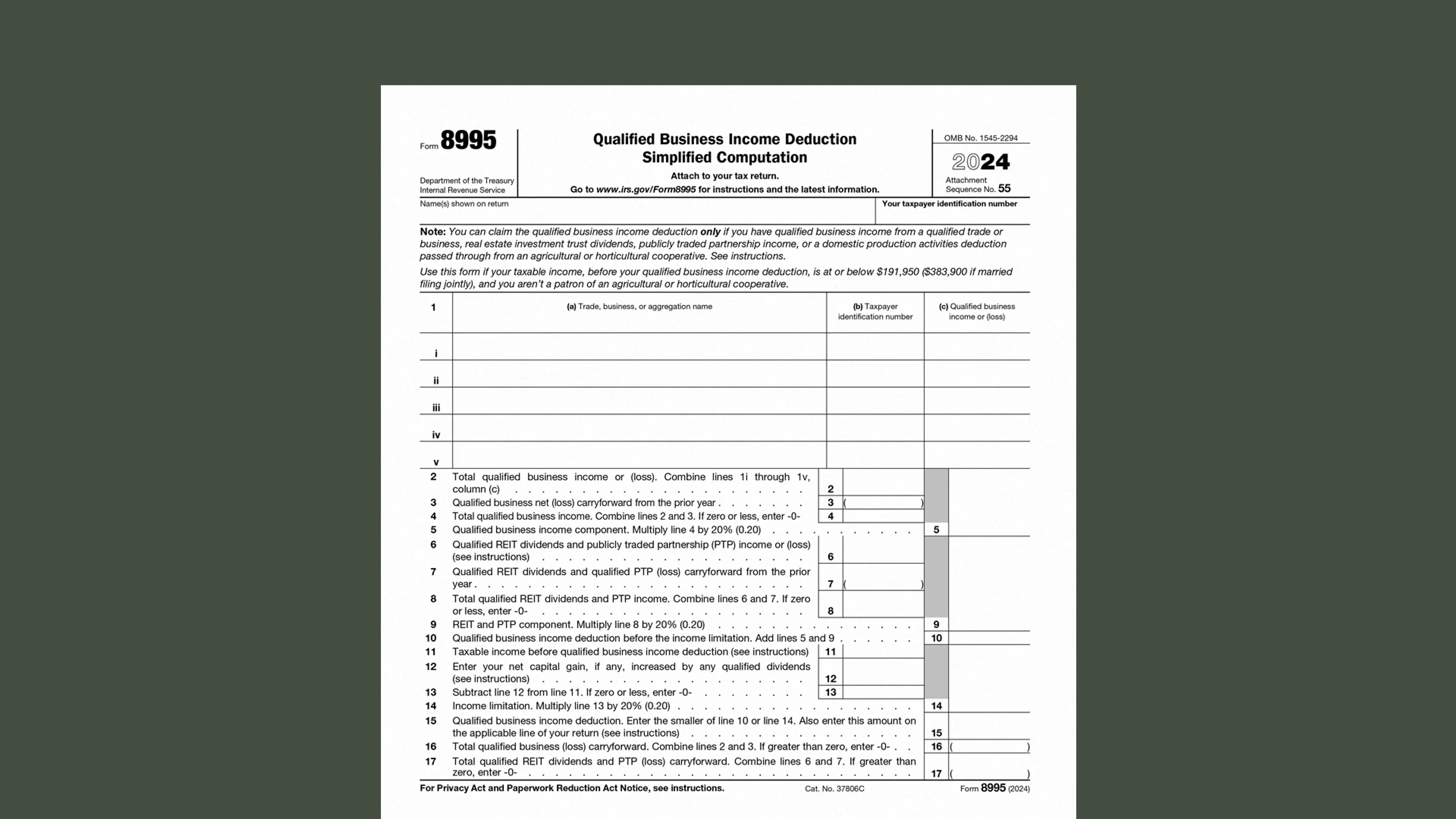
- Form 8995 is commonly used for simpler situations, often when you are under the taxable-income threshold and do not have additional components.
- Form 8995-A is used for more complex situations, including many returns above the threshold or with additional components and calculations.
Either way, the result flows to your Form 1040 as the qualified business income deduction.
Why QBI can be zero
If you take the standard deduction and your QBI deduction is coming out as zero, it is usually because of eligibility rules, not because you did not itemize. A few common culprits:
- No qualified business income: For example, you had a net loss on Schedule C, or the income is not considered QBI.
- It is not a pass-through business: W-2 wages from a job do not create QBI.
- Taxable income limitations: Once taxable income is above the threshold, additional limits can apply, including wage and property limits and the SSTB phaseout rules.
- Entity and payment types: Certain items like reasonable compensation (S corporation wages) and guaranteed payments are not QBI.
- Taxable income cap: Even below the threshold, the QBI deduction cannot exceed 20% of taxable income (minus net capital gains).
If you are near the threshold, small planning moves (timing income, retirement contributions, or major expenses) can change whether the full 20% is available. This is one of those areas where tax planning is often more valuable than tax prep.
Quick FAQ
Does the standard deduction reduce my QBI deduction?
It can, indirectly. QBI is limited by your taxable income, and the standard deduction lowers taxable income. That is often good, but it can also lower the maximum allowed QBI deduction because the QBI deduction cannot exceed 20% of taxable income (minus net capital gains). The important point is that the standard deduction does not disqualify you.
Is QBI an above-the-line deduction?
No. QBI does not reduce AGI. It reduces taxable income after AGI is calculated.
If I have a side hustle, can I take QBI and the standard deduction?
Often, yes, if your side hustle is a qualified trade or business and you have qualified business income. Many Schedule C filers who take the standard deduction still qualify.
Bottom line
If you are eligible for the QBI deduction, taking the standard deduction does not block it. You can think of QBI as a separate layer that comes after AGI and works alongside whichever deduction method you choose.
If you want a practical next step, pull up last year’s return and locate your AGI, your standard or itemized deduction, and then the QBI deduction line. Seeing the ordering on your own numbers makes this concept click fast.