If you own more than one business, the QBI deduction can feel a little unfair. One company may throw off plenty of qualified business income, but not enough W-2 wages or qualifying property to pass the limitation. Another company might have payroll and equipment, but not much profit. So the natural question is: can you combine them so the wage and property test works in your favor?
Sometimes, yes. The tax law allows an optional Section 199A aggregation election that lets certain commonly owned businesses be treated as one for purposes of the W-2 wage and qualified property limitation. But it is not a free-for-all, and it is not just “same owner, so we can group it.”

Below, I will walk you through the tests in plain English using one owner with two operating companies. I will also explain the restriction that surprises people most: specified service trades or businesses generally cannot be aggregated with non-specified businesses.
What aggregation does and does not do
Aggregation under Section 199A is mainly about one thing: applying the W-2 wage and qualified property (UBIA) limitation across a group of businesses instead of separately.
Aggregation does not:
- Merge your legal entities.
- Turn non-QBI income into QBI.
- Change whether a business is an SSTB.
- Let you dodge the overall taxable income thresholds that determine when limitations apply.
Aggregation can:
- Allow wages from Business A to support the QBI deduction from Business B.
- Allow qualified property in one business to help satisfy the limitation for another business.
Think of it like adding two business “baskets” together only for a specific test, the wage and UBIA limit test. You still track each business’s QBI and other attributes, but the limitation math is run on the combined group.
One owner, two companies
Meet Maya. She owns two companies:
- Lakeshore Fabrication, LLC: a manufacturing business with equipment and employees, but profit is modest this year.
- Lakeshore Sales & Service, LLC: a related business that sells and installs the manufactured product, with higher profit but relatively low wages because she uses subcontractors for some field work.
If Maya calculates QBI separately, the Sales & Service company may hit a wage and property limitation that reduces the deduction. Aggregation is appealing because the Fabrication company has W-2 wages and depreciable equipment that could “support” the combined limitation.
The key question becomes: Are these two businesses eligible to be aggregated?
The aggregation tests
The rules are detailed, but the decision is basically a three-part gate:
- Common ownership
- Eligible taxpayers and entity types (pass-through QBI)
- Economic relationship, proven through specific factors
1) Common ownership: the 50% rule
To aggregate, the same person or group of persons must own 50% or more of each business to be grouped, and that ownership has to exist for a majority of the tax year. Ownership is measured using special attribution rules, meaning certain family and entity ownership can be treated as yours even if you do not hold the shares directly.
In Maya’s case, she owns 100% of both LLCs, so she clears this gate easily.
2) Eligible taxpayers and entity types
Section 199A applies to qualified trades or businesses conducted through pass-through structures, such as S corporations, partnerships, or sole proprietorships. C corporation income is not eligible for the QBI deduction at all, so it is not something you would aggregate for Section 199A purposes.
If both of Maya’s companies are pass-throughs (for example, two S corps or two partnerships, or one of each), this requirement is typically workable.
3) They must be connected: meet 2 of 3 relationship factors
This is where the IRS tries to prevent “mix and match” grouping that is only done for a bigger deduction. The businesses must satisfy at least two of the following three factors:
- Products or services are the same or customarily offered together. Example: making a product and installing it, or selling a product and providing the related service.
- They share facilities or significant centralized business elements. Think shared accounting, HR, legal, billing, scheduling, IT, purchasing, or shared office or warehouse space.
- They are operated in coordination with, or reliance upon, one or more of the businesses in the group. For example, one company exists largely to supply the other, or their operations are tightly linked.
Maya’s Fabrication and Sales & Service companies often meet all three. They sell and install the same product line, they share back-office functions, and one relies on the other for inventory and job fulfillment. That is the kind of real operational connection the aggregation rules are aiming for.

How aggregation helps with limits
Once you are above the taxable income threshold where the W-2 wage and qualified property limitation begins to phase in, your QBI deduction can be capped based on a formula tied to:
- W-2 wages paid by the business, and/or
- Qualified property (UBIA), meaning the unadjusted basis immediately after acquisition of certain tangible, depreciable property that is held by and available for use in the business (and still within its depreciable period).
This is where aggregation can be powerful. If you have one business that is wage-light but profit-heavy, and another that is wage-heavy or equipment-heavy, aggregation can increase the total wages or UBIA available for the limit calculation.
Back to Maya:
- Sales & Service produces most of the QBI, but uses fewer W-2 employees.
- Fabrication carries more W-2 wages and has expensive equipment.
Aggregating can let Fabrication’s payroll and qualified property support the limitation applied to the combined QBI, which may increase the allowable deduction compared to treating each business separately.
One practical caution: aggregation is not automatically a win. If one business generates losses, has complicated allocations, or creates unfavorable interactions with other limitations, you need to run the numbers.
Why SSTBs are different
This is the big line in the sand.
A specified service trade or business (SSTB) is a category of business where the QBI deduction is limited or phased out at higher income levels, largely because the income is considered tied to reputation or skill. Common examples include many professional services like law, accounting, consulting, financial services, health, and certain other service fields.
You generally cannot aggregate an SSTB with a non-SSTB. Put differently, aggregation is generally done either among non-SSTBs, or among SSTBs, if all other requirements are met. You do not get to blend an SSTB into a non-SSTB group to use wages and property from the non-SSTB as a support beam.
Example: the setup that triggers problems
Suppose Maya also owns:
- Navarro Advisory, LLC: a consulting firm (likely an SSTB).
- Lakeshore Fabrication, LLC: manufacturing (non-SSTB).
She might be tempted to aggregate them so the manufacturing payroll and qualified property increase the wage and property amounts supporting the group. That is exactly the kind of cross-category blending the SSTB restriction is intended to block.
Also watch “crack-and-pack” risk
The IRS also has rules aimed at businesses that try to separate an SSTB into pieces, then label the pieces as non-SSTB activities. For example, where there is 50% or more common ownership and a non-SSTB entity primarily provides property or services to the SSTB (often discussed as an 80% or more relationship), part or all of that non-SSTB can be treated as an SSTB for QBI purposes, which can wipe out the expected benefit.
If you are splitting entities primarily to improve the QBI outcome, this is a situation where you want your CPA involved early, not after year-end.

What can be grouped
In my experience, aggregation is most defensible when the businesses are genuinely part of the same operational machine. Examples that often align with the relationship factors include:
- Manufacturing plus distribution, sales, or installation of the same products
- A group of retail locations under the same brand and centralized back office
- Related service lines that are customarily offered together, using the same workforce and systems
Aggregation tends to be harder to justify when businesses share an owner but not a business reality. For example, owning a landscaping company and a separate e-commerce store with no shared systems, no shared operations, and no shared customer offering is usually a stretch.
The election and reporting
Aggregation is elective, and the election is made at the taxpayer level (for example, the individual, trust, or estate claiming the deduction), not at the entity level. In multi-owner situations, that matters because one owner may choose to aggregate and another owner may not, even if they own interests in the same underlying businesses.
In practice, aggregation is reported on Form 8995-A, generally using Schedule B and the attached aggregation statement. That disclosure typically identifies each trade or business in the aggregated group (including names and EINs) and describes the ownership and the relationship factors you are relying on.
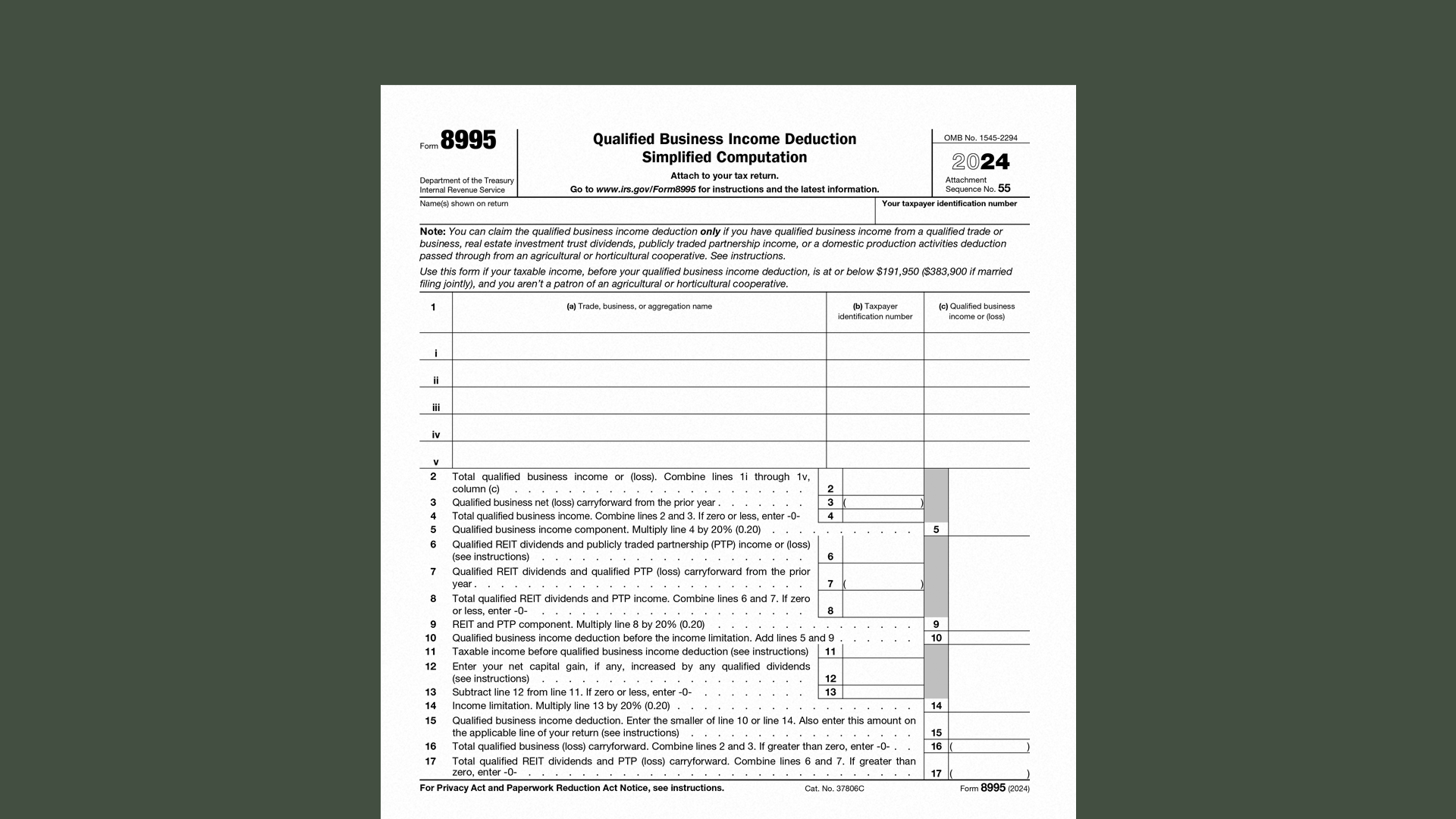
Form 8995 (the simplified form) does not provide a dedicated place to disclose aggregation. So if you are aggregating, you should typically expect to be in the Form 8995-A workflow so the required disclosure travels with the return.
One more point that gets missed: once you establish an aggregation grouping, you are expected to apply it consistently in later years unless there is a material change in facts and circumstances. And you generally keep disclosing the aggregation each year you use it, not just in the first year.
Also remember what aggregation is and is not: it is for applying the wage and UBIA limitation across the group. You still compute and track the underlying QBI, W-2 wages, and UBIA by trade or business, and then apply the limitation on an aggregated basis.
Common questions
Do the businesses need to be in the same industry?
Not exactly, but they need to meet at least two of the three relationship factors. Same industry is helpful, yet not required if the operational tie is strong and well-documented.
Can I choose to aggregate one year and not the next?
Aggregation is an election, and once you choose a grouping, there are consistency expectations. Changes can be allowed, but you should treat this as a strategic decision, not a yearly toggle based only on where you land for income. If there is a material change in facts and circumstances, updating the grouping is more defensible.
What kind of documentation should I keep?
Keep records that show the operational connections, not just the tax result. Examples include shared service agreements, organizational charts, evidence of centralized accounting and HR, leases showing shared facilities, and narratives explaining how the businesses coordinate.
Does aggregation apply to REIT, PTP, or cooperative items?
This article is focused on aggregating trades or businesses for the wage and qualified property limitation. REIT dividends and publicly traded partnership items have their own buckets and calculation rules, and they are not something you simply “group” with an operating business for the wage and property test.
My take before you aggregate
I grew up watching my parents run a mid-sized agricultural supply company, and I still remember how often the “simple” question, can we treat this as one thing, turned into a tangle of payroll, equipment, seasonal financing, and tax consequences. QBI aggregation is similar. It looks like a quick fix until you realize it is also a compliance and consistency commitment.
If you are considering aggregation, here is the order I like:
- Confirm eligibility (ownership, entity type, and at least two relationship factors).
- Run the math both ways (separate vs aggregated) including loss scenarios.
- Stress-test SSTB exposure if any entity touches specified service activity.
- Decide the grouping intentionally, knowing you may be living with it for a while.
When done correctly, aggregation can be a perfectly legitimate way to reflect how your businesses actually operate, and it can protect more of your QBI deduction when the wage and property limits start to bite.