
If you are self-employed, there is a weird moment that catches almost everyone off guard: you are making money, business feels real, and then the IRS expects you to pay taxes before you file your return.
Quarterly estimated taxes are not a special tax. They are simply a payment schedule for income tax and, for many freelancers and small business owners, self-employment tax. The goal is to pay as you earn so you do not end up with a nasty bill and penalties later.
Who should make quarterly estimated payments
You may need to make quarterly estimated payments if both of these are true:
- You expect to owe at least $1,000 in federal tax after subtracting withholding and refundable credits.
- You do not have enough tax withheld from wages, Social Security, pensions, or other sources to cover what you will owe.
More precisely, the IRS underpayment rules (and the safe harbors below) determine whether you might owe a penalty. So think of this section as: who should plan to pay estimates, not a hard-and-fast rule that applies to every taxpayer in every scenario.
This often applies to:
- Freelancers and independent contractors paid on 1099-NEC or 1099-K
- Sole proprietors (including single-member LLCs taxed as sole props)
- Partners in partnerships and many LLC members
- S-corp owners if their salary withholding is not enough to cover total tax on salary plus pass-through profit
- Investors with meaningful dividends, capital gains, or rental income and little to no withholding
Common surprises
- You have a W-2 job plus a side gig. Your paycheck withholding may not cover tax on the side income, especially once the side income grows.
- You started freelancing mid-year. No one is withholding taxes for you anymore.
- You had a big one-time win. A large contract, a big capital gain, a severance package without enough withholding, or a profitable year after prior losses.
Not sure if you fall into this bucket? A practical way to think about it is this: if taxes are not being withheld for you, the IRS expects you to “self-withhold” through estimated payments.
What your quarterly payments cover
For most self-employed people, estimated payments typically include:
- Federal income tax based on your taxable income and tax bracket
- Self-employment (SE) tax, which covers Social Security and Medicare for self-employed earners
SE tax is the one that stings because it is easy to forget. When you are a W-2 employee, your employer pays half of these payroll taxes. When you are self-employed, you cover both halves yourself.
Heads up: This article focuses on federal estimated taxes. Many states have their own estimated tax requirements and schedules, so it is worth checking your state Department of Revenue for due dates and thresholds.
Safe harbor rules (avoid penalties)
The IRS can charge an underpayment penalty if you do not pay enough throughout the year. The good news is there are “safe harbors” that, if you meet them, generally protect you from penalties even if you still owe at filing time.
Two common safe harbors
- Pay at least 90% of the current year total tax.
- Pay 100% of the prior year total tax (110% if your prior year adjusted gross income was over $150,000, or over $75,000 if married filing separately).
For many growing business owners, the prior-year safe harbor is the easiest to use because it is a known number. It is also the one that helps you sleep at night during a breakout year when income is rising fast.
Quick caveat: If you did not file a full 12-month prior-year return, or you had no prior-year tax liability, the prior-year safe harbor may not work the way you expect. In that case, it is worth checking the Form 1040-ES instructions or confirming with a tax pro.
Why safe harbors matter
If your income is uneven, seasonal, or hard to forecast, safe harbors give you a clear target so you can avoid penalties without needing perfect predictions.
Mentor-style rule of thumb: if your income is stable, aim for the 90% current-year approach. If your income is rising quickly or unpredictable, use the prior-year safe harbor and reassess mid-year.
Quarterly due dates
Estimated payments are due four times a year. They are not spaced evenly by three months, which is part of the confusion.
| Payment | Income period covered | Due date |
|---|---|---|
| Q1 | Jan 1 to Mar 31 | April 15 |
| Q2 | Apr 1 to May 31 | June 15 |
| Q3 | Jun 1 to Aug 31 | September 15 |
| Q4 | Sep 1 to Dec 31 | January 15 (next year) |
If a due date falls on a weekend or federal holiday, it typically shifts to the next business day. Also note that the April deadline can move in some years due to Washington, DC holidays (like Emancipation Day) and the IRS will publish the adjusted date.
You can skip the January 15 payment in some cases if you file your tax return and pay your full balance by January 31. Many people still pay Q4 on January 15 anyway for simplicity.
How to estimate what to set aside
There are two main approaches: the “safe harbor” method (simple and penalty-focused) and the “projected income” method (more accurate for avoiding a big bill). Below is a step-by-step method that starts with net self-employment income, because that is what most freelancers and owners can estimate without a tax degree.
Step 1: Estimate net self-employment income
Start with expected business revenue for the year, then subtract ordinary and necessary business expenses.
- Expected revenue: what you will invoice or receive
- Minus expenses: software, supplies, subcontractors, mileage, home office (if eligible), insurance, professional fees, etc.
Net self-employment income = Revenue − Business expenses
Step 2: Estimate self-employment tax
Self-employment tax is calculated on roughly 92.35% of your net self-employment income.
SE tax base = Net self-employment income × 0.9235
Estimated SE tax = SE tax base × 0.153
(That 15.3% is the combined Social Security and Medicare rate. The Social Security portion applies only up to the annual wage base. Higher earners may also owe Additional Medicare Tax, which is calculated separately on Form 8959.)
Step 3: Estimate income tax
This is the part that varies the most, because it depends on your filing status, other income, deductions, and credits. A workable method is:
- Estimate your total taxable income (business profit plus other income, minus deductions).
- Use last year’s effective tax rate if your situation is similar, or run a quick projection using a reputable tax calculator.
- If you are doing a rough upper-bound estimate, you can look at your marginal bracket, but remember the U.S. tax system is progressive, so your whole income is not taxed at that top rate.
Small but important note: when estimating income tax, remember you typically get an above-the-line deduction for half of your self-employment tax, which can make your income tax a bit lower than a simple “profit times tax rate” estimate.
Step 4: Combine and divide (or match seasonality)
Estimated annual federal tax ≈ Estimated income tax + Estimated SE tax
Quarterly set-aside = Estimated annual federal tax ÷ 4
If your income is seasonal, the annualized income installment method can be a better fit. It lets you pay more in high-income quarters and less in slower quarters, and it is worked out on Form 2210 (Schedule AI).
Simple example (round numbers)
Let’s say you expect:
- Revenue: $120,000
- Expenses: $30,000
- Net self-employment income: $90,000
SE tax base: $90,000 × 0.9235 = $83,115
Estimated SE tax: $83,115 × 0.153 ≈ $12,717
Now assume your federal income tax estimate for the year is $10,000 (this depends heavily on your household situation and will be affected by deductions, including the deduction for half of SE tax).
Estimated annual federal tax: $12,717 + $10,000 = $22,717
Estimated quarterly payment: $22,717 ÷ 4 ≈ $5,679
That number might feel high the first time you see it. But it is better to discover it while you still have the cash than at filing time when you are also trying to fund next year’s taxes.

Use safe harbor to pick a number fast
If you want a straightforward number you can defend, do this:
- Find your total tax from last year’s return (often labeled “Total tax”).
- If last year’s AGI was over $150,000 ($75,000 MFS), multiply that total tax by 110%. Otherwise use 100%.
- Subtract any tax you expect to have withheld this year (for example, from a spouse’s W-2).
- Divide the remainder by four.
This approach does not guarantee you will not owe more at filing time, especially if this year is much more profitable. It does, however, usually keep you clear of underpayment penalties.
How to pay
You can pay estimated taxes by:
- IRS Direct Pay from a bank account
- EFTPS (the Electronic Federal Tax Payment System) if you want an account-based system that is great for recurring payments
- Debit or credit card through an IRS-approved payment processor (usually with fees)
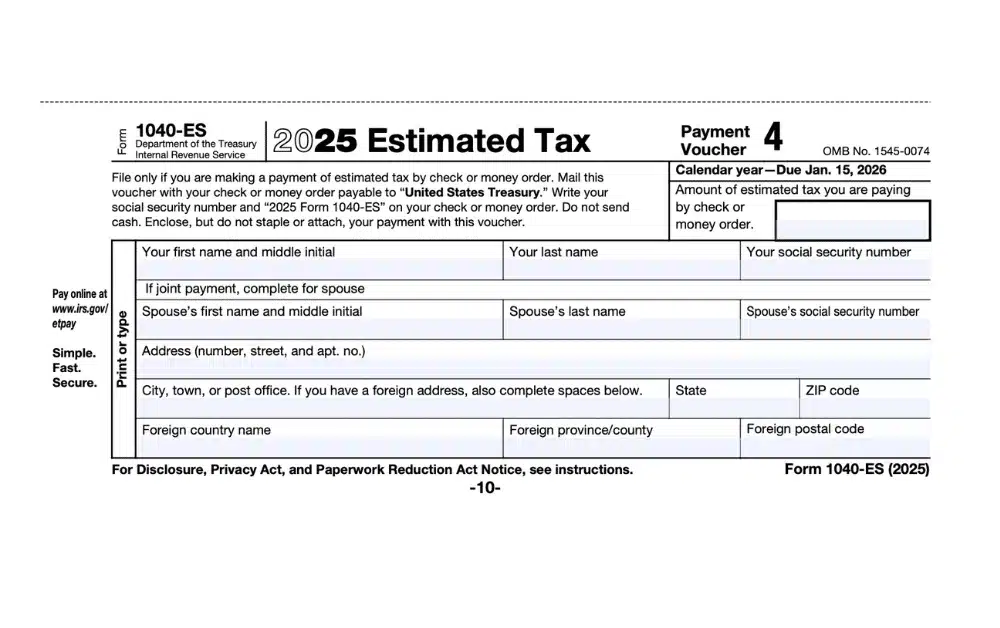
- Mailing a check with a voucher from Form 1040-ES
When you pay online, be sure you are applying the payment to the right category and year. Generally you will select Estimated Tax and the correct tax year (and keep the confirmation number). You can also view payments through your IRS Online Account.
For simplicity, I like a repeatable routine: use EFTPS or Direct Pay, calendar the dates, and keep a running tax set-aside in a separate savings account.
Cash flow habits that help
Quarterly taxes are less about math and more about cash flow. These habits make it feel manageable.
1) Use a separate tax account
Every time client money hits your business checking, immediately move a percentage into a dedicated tax savings account. Treat it like it is not yours.
2) Base it on net income when you can
If your expenses swing month to month, saving a percentage of revenue can overfund in slow months and underfund in heavy-expense months. If you can, base it on net income or on revenue minus your most consistent variable costs.
3) Automate two reminders
- Monthly: reconcile income and expenses, estimate profit
- Quarterly: confirm your estimated payment amount and submit the payment
4) Keep a buffer
Aim to keep one extra month of tax set-aside as a cushion. It helps when a client pays late or an expense hits at the wrong time.
5) Re-estimate mid-year
If your income is trending higher, adjust early. Waiting until December usually means scrambling.

Special cases
W-2 plus freelance income
You might not need to make quarterly payments if you increase withholding at your day job enough to cover the extra tax. This is a legitimate strategy, and it can be simpler than quarterly payments because withholding is treated as if it was paid evenly throughout the year.
New business, first profitable year
Your prior-year safe harbor may be low because last year’s total tax was low. You may avoid penalties but still owe a lot at filing time. If cash flow allows, “safe harbor plus extra” is often the best compromise.
S-corp owners
Your S-corp salary withholding can cover a big chunk of your tax obligation if set correctly. But pass-through profit can still create a quarterly payment need. This is where coordinating with your payroll provider and CPA matters.
High-income earners
Additional Medicare Tax thresholds, the Social Security wage base limit, and other taxes tied to investment income can change the picture. At that point, it is worth running a more precise projection.
FAQ
What if I miss a quarterly payment?
You may owe an underpayment penalty and interest. If you catch it quickly, paying as soon as possible can reduce the damage. If your income was uneven, the annualized method (Form 2210, Schedule AI) may also help show you did not underpay earlier relative to what you earned.
Do I have to pay four equal payments?
No. The IRS cares that enough tax is paid by each due date based on what you earned (or based on safe harbor targets). Equal payments are just the simplest way to execute.
Is quarterly tax the same as filing quarterly returns?
No. Most freelancers do not file a quarterly return. You are making quarterly payments, then you file your normal annual tax return.
How much should I set aside?
There is no universal percentage, but many freelancers start by setting aside around 20% to 35% of net income for federal taxes and then adjust based on their actual bracket, deductions, and credits. If you are also saving for state and local taxes, you may need a higher percentage.
A calm way to start
If you are feeling behind, do not try to solve the whole year in one sitting. Do this instead:
- Estimate this quarter’s net profit.
- Choose a safe baseline percentage to set aside.
- Make the payment by the due date.
- Schedule a 30-minute mid-year check-in to refine your numbers.
Quarterly estimated taxes are one of those adulting milestones no one glamorizes. But once you build the rhythm, it becomes just another business system, and a surprisingly empowering one.