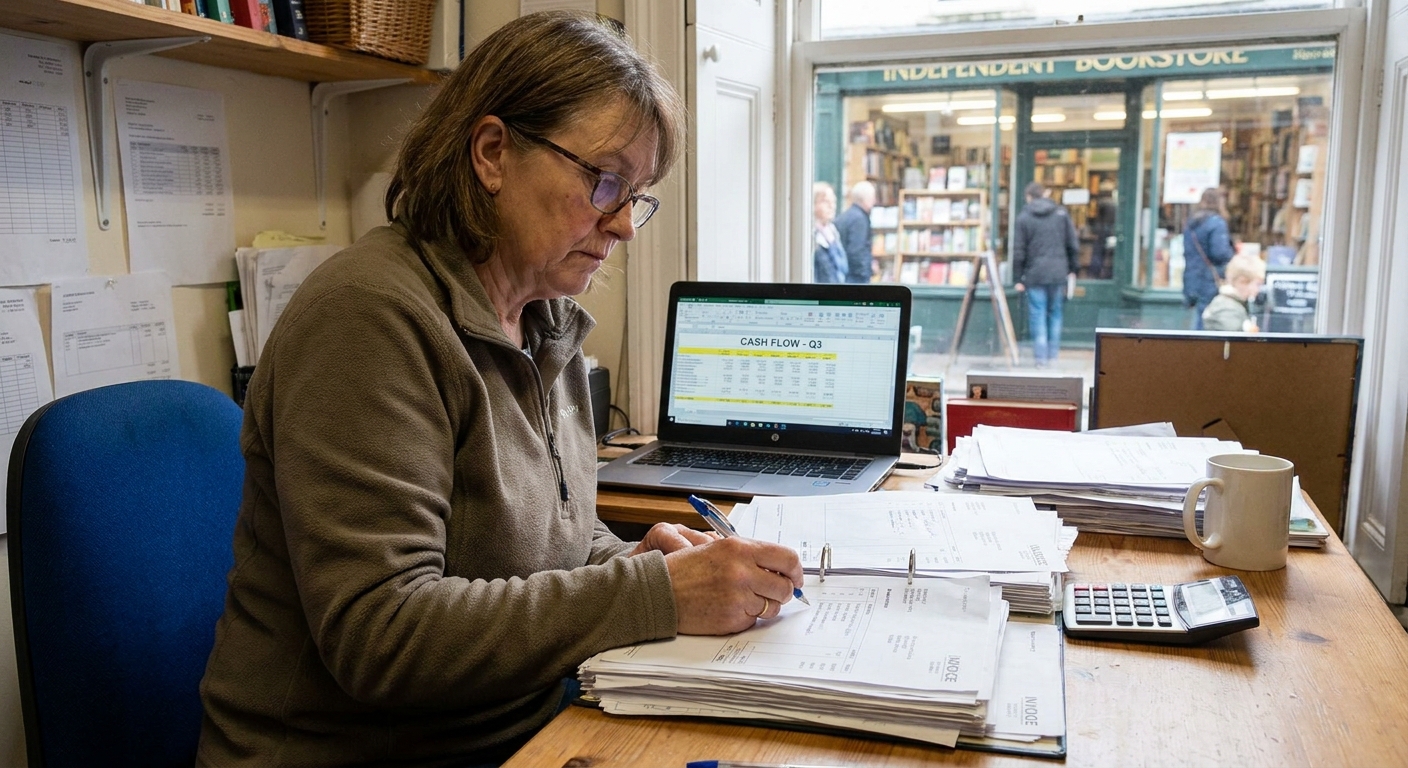
I grew up watching my parents run a mid-sized agricultural supply company, and I can still remember the way cash flow stress changed the mood of a room. It was not just “Do we have profit this year?” It was “Can we make payroll next Friday if a big customer pays late?” That same pressure shows up today for retailers, salons, restaurants, and ecommerce brands, especially when inventory bills and tax deadlines do not care that sales are seasonal.
Two common ways owners plug a short-term gap are a merchant cash advance (MCA) and a business line of credit (LOC). They both put money in your account fast, but they behave very differently once repayment starts. Below, I will walk you through the mechanics using one retailer with steady card volume and access to a bank line, so you can see exactly how a factor rate differs from interest on draws, and what a slow sales week does to your payment.
Quick definitions
Merchant cash advance (MCA)
An MCA is often structured as a purchase of future receivables, not a traditional term loan. In a classic MCA structure, a provider advances you money today and collects repayment by taking an agreed-upon percentage of your card sales until a fixed total is collected. That percentage is commonly called a holdback, and you may also hear withholding percentage or “retrieval” terminology depending on the provider.
One important nuance: not everything marketed as an MCA works like a true sales-percentage sweep. Some products use fixed daily ACH debits based on estimated revenue, and only sometimes offer reconciliation (a payment adjustment) if sales drop. The contract language determines which version you are actually getting.
Business line of credit (LOC)
A business line of credit is revolving credit. You get approved for a maximum limit, you draw what you need, and you pay interest on the amount you actually use. Some LOCs allow interest-only payments during a draw period, but many small-business lines require a minimum payment that includes principal, so it depends on the lender and the structure.
In plain English: with a line, the meter runs based on balance and time. With an MCA, the total you pay back is often more like a fixed price tag that you satisfy through slices of your revenue.
Factor vs interest rate
If you have ever thought, “The factor rate looks small, so the cost must be reasonable,” you are not alone. The problem is that a factor rate is not an annualized interest rate.
How a factor rate works
A factor rate is usually something like 1.20 to 1.45. You multiply it by what you receive.
- If you receive $50,000 at a 1.30 factor rate, your total repayment is $65,000.
- That means the cost is $15,000, and that cost typically does not shrink just because you repay faster. (Some contracts offer a discount, many do not.)
The “rate” does not include time. If you end up repaying that $65,000 in 6 months versus 12 months, the same $15,000 cost is compressed into a shorter window, which can make the effective APR very high.
How interest on a line works
With a line of credit, you have an APR (for illustration only, bank pricing varies widely with Prime or SOFR, collateral, and borrower risk). You pay interest based on:
- How much you drew
- How long you carried the balance
Repay faster, pay less. Carry it longer, pay more. That math model is fundamentally different from an MCA.
A retailer example
Let’s use a simple retailer scenario so you can see how the repayment behaves in real life.
Business: A neighborhood apparel store in Chicago
Card sales volume: Averages $100,000 per month in card receipts (about $25,000 per week)
Need: $50,000 to buy seasonal inventory and cover a one-time cash crunch
Option A: MCA
Advance received: $50,000
Factor rate: 1.30
Total payback: $65,000
Holdback rate: 12% of card sales (example structure)
Normal week
Assume the store does $25,000 in card sales this week.
- Holdback = 12% of $25,000 = $3,000 paid to the MCA provider
In a typical week, $3,000 flows out via the sweep or debit before the owner has a chance to allocate that cash to staff, rent, inventory, and taxes. That is the operational reality many owners feel first.
Slow week
Now assume a bad week: card sales drop to $15,000.
- Holdback = 12% of $15,000 = $1,800
Two things are true at the same time:
- The payment drops, which can provide short-term breathing room.
- The obligation usually does not shrink. You still owe the same total payback ($65,000). A slow stretch often means the MCA stays attached to your sales longer.
Great week
Assume a strong week: $35,000 in card sales.
- Holdback = 12% of $35,000 = $4,200
Yes, you pay down the balance faster. But you are still paying toward that same $65,000 total. Many owners experience this as a growth tax because big weekends do not just replenish cash, they also trigger bigger sweeps.
Rough timeline
Here is what the timeline looks like if sales stay near the average. At $25,000 per week in card sales and a 12% holdback, you are paying about $3,000 per week.
- Estimated weeks to collect $65,000: $65,000 / $3,000 ≈ 22 weeks
That is not a promise, it is just the math at the current sales pace. In the real world, the timeline moves with volume, and your contract determines whether and how reconciliation works if sales fall.
Option B: Line of credit
Line limit: $100,000 approved
Draw needed: $50,000
APR: 12% (illustrative example only)
Repayment approach: Minimum monthly payment (often interest plus some principal, depending on terms)
How interest is calculated
At 12% APR, the monthly interest rate is roughly 1%. Using simple math (actual statements may use daily accrual, 365 or 360-day conventions, and compounding):
- Monthly interest on a $50,000 balance is about $500.
If the retailer carries the $50,000 for 6 months before paying it down, total interest is about:
- $500 x 6 = $3,000 (approximate)
The key comparison stays the same: with a line, you pay for time and balance, not a fixed factor-cost.
Slow week behavior
If sales are slow, your LOC payment usually does not automatically decrease based on revenue. You still owe the minimum payment on schedule. The line is often cheaper, but it can be less self-adjusting during a slump. That is why the best line users map repayment before they draw, not after.
Fees and requirements to ask about
LOC pricing is not just the APR. Ask about:
- Annual fees, draw fees, or unused line fees
- Personal guarantee requirements
- Collateral or blanket lien terms
- Financial reporting or covenant requirements (even basic ones)
Cost comparison
Using the same $50,000 cash need:
- MCA total cost (example): $15,000 (because $65,000 payback minus $50,000 received)
- LOC interest cost (example): about $3,000 if carried for 6 months at 12% APR
Could the LOC cost more? Yes, if you carry the balance for a long time, if your APR is higher, or if there are meaningful fees. But in many real scenarios I see with retailers, the MCA ends up more expensive because the factor cost is set from day one.
An MCA APR illustration (estimate)
I do not love forcing MCA pricing into an APR box because repayment is volume-driven, but an illustration helps explain the sticker shock. In the example above, the provider collects $65,000 total on a $50,000 advance.
- If it takes about 22 weeks (roughly 5 months), paying $15,000 to use $50,000 for about 5 months works out to an effective annualized cost that can land in the triple digits, depending on the exact timing and cash flow pattern.
That is why a factor rate that “looks like 1.30” can still be extremely expensive when the payback happens quickly.
Also, the invisible cost of an MCA is operational. A daily or weekly sweep can create a second cash crunch, especially in businesses with thin margins, heavy payroll cycles, or big inventory buys.
Cash flow behavior
Here is the most practical way I explain this to clients.
MCA flexibility
- Payments can flex with revenue when the structure is a true holdback on sales.
- Total payback is usually fixed because the factor rate determines the dollar amount collected.
- Cash flow impact is persistent because a slice of receipts is diverted before you make other spending decisions.
LOC flexibility
- You pay interest only on what you draw.
- Total cost is variable because it depends on time to repayment and fees.
- Cash flow impact is more controllable because you decide when to draw and how aggressively to pay down, within your terms.
When an MCA can work
I am not here to say MCAs are always “bad.” I am here to say you should use them with eyes open, because the pricing model is easy to misunderstand, and the contract details matter.
An MCA can be a fit when:
- You have strong, consistent card volume and the holdback will not starve operations.
- You need funding fast and you cannot qualify for a bank line today.
- You are using it for a high-confidence, short payback cycle, like inventory that is already pre-sold or a campaign with predictable ROI.
- You have a clear exit, such as refinancing to a lower-cost product once bank statements and credit improve.
If you go the MCA route, ask the provider to clearly state, in writing:
- Total payback amount in dollars
- Holdback or withholding percentage, and whether it is a true percentage of sales
- Whether payments are a variable sweep or fixed ACH, and what triggers changes
- Reconciliation policy (how to request it, how often it can happen, and what documentation is required)
- All fees (origination, underwriting, admin), and the net funded amount you will actually receive
- Whether there is any discount for early payoff (many contracts have none)
- Any fees or penalties tied to restructuring, renewals, or stacking
When a line is better
A line of credit is often a stronger fit when:
- You can qualify for bank or credit union terms.
- Your business has recurring working capital needs, such as inventory cycles or delayed receivables.
- You want the option to borrow $10,000 this month, repay, then borrow again, without reapplying.
- You have the discipline to treat it like a bridge, not permanent capital.
One practical tip: if you are a retailer with seasonal spikes, ask about a cleanup period (a requirement to bring the balance to zero for a certain number of days each year). Banks like it, and it keeps you honest.
Red flags
MCA red flags
- Only the factor rate is disclosed, not the total payback in dollars and the net funded amount after fees.
- Fixed daily debits are presented as “based on sales,” but reconciliation is unclear or difficult to access.
- Stacking pressure, meaning you are encouraged to take another advance before the first is repaid.
- Vague language about what happens if sales drop for an extended period.
Line of credit red flags
- Variable APR without a clear explanation of what index it tracks and how often it resets.
- Surprise fees, such as inactivity fees, annual fees, or draw fees, that were not discussed up front.
- Collateral or blanket lien terms you do not understand. Ask questions. This is standard bank paperwork, but you should know what you are agreeing to.
Decision checklist
- How fast will this money turn into cash? If it is truly short-cycle, a line is often cheaper. If it is uncertain, both products get riskier.
- Can you handle a sweep off the top? If an MCA holdback would make payroll tight, do not rationalize it.
- Do you have a one-page repayment plan? If you cannot write the plan on one page, you are not ready to borrow yet.
- What is your plan B? For an MCA, plan B might be refinancing or negotiating reconciliation terms. For a line, plan B might be slowing draws, cutting discretionary spend, and locking a payoff date.
FAQ
Is an MCA cheaper because payments drop in slow weeks?
Not necessarily. Payments can drop when they are tied to sales, but the total payback is typically fixed from day one. Slow weeks often mean you pay for a longer period, not that you pay less overall.
Can I calculate an APR from a factor rate?
You can estimate an effective APR if you know the total payback and the expected time to repay. Because repayment timing depends on sales (and on whether the product truly reconciles), the effective APR can swing widely. That uncertainty is part of the risk.
Does a line of credit always require collateral?
No. Some lines are unsecured, but many bank lines use a blanket lien on business assets, and stronger pricing often comes with stronger collateral. If you are unsure, ask the lender to explain the collateral and guarantee terms in plain language.
What if I have a line but my bank is slow?
Timing is real. If you anticipate a need, start the LOC process before you are in a pinch. In my experience, the cheapest money is the money you qualify for before you desperately need it.
Bottom line
If you are a retailer with steady card volume and access to a bank line, a business line of credit is usually the lower-cost tool for bridging cash flow gaps because you pay interest on the amount and time you actually use. A merchant cash advance is often the higher-cost tool, but it can feel easier in the moment because payments can flex with sales through a holdback or sweep.
Before you choose, run the decision through one simple lens: Is this financing helping your cash cycle, or taxing it? If it is taxing it, the “fast approval” will not feel worth it a few weeks later when the debits start landing.