When my parents were running their agricultural supply business, they used every type of financing you can imagine. Some loans were “cheap” on paper but came with strings attached. Others were more expensive but let them sleep at night because the house was not on the line.
That same tradeoff shows up in the HELOC vs personal loan decision. A HELOC can be a flexible, often lower-rate way to fund a big project, but it is tied to your home. A personal loan is usually simpler and faster, with no lien on your property, but the rate can be higher and the payment is less flexible.

Quick definitions
What a HELOC is
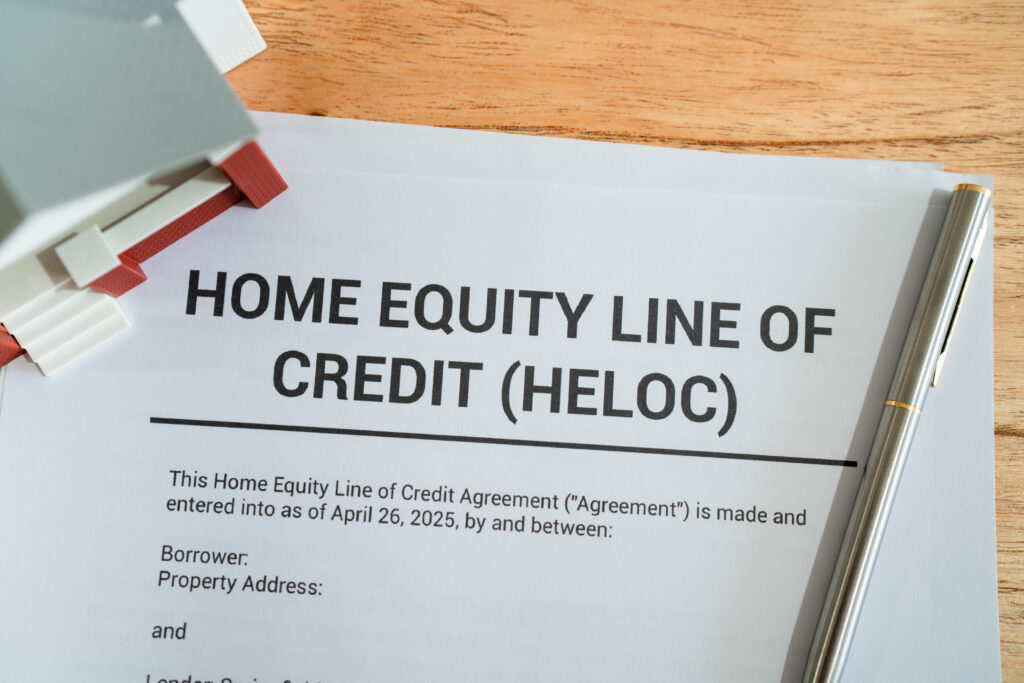
A home equity line of credit (HELOC) is a revolving credit line secured by your home. You typically get:
- A credit limit based on your home equity
- A draw period (commonly 5 to 10 years) where you can borrow, repay, and borrow again
- A repayment period (commonly 10 to 20 years) after the draw period ends
- Variable interest rates are common, although some lenders offer fixed-rate conversion options for all or part of the balance
Because your home is collateral, the lender records a lien, similar to a second mortgage.
What a personal loan is
A personal loan is usually an unsecured installment loan. You borrow a lump sum, then repay it in fixed monthly payments over a set term. In most cases:
- No collateral is required
- Rates can be fixed, so payments are predictable
- Funding can be fast once approved
HELOC vs personal loan at a glance
| Feature | HELOC | Personal loan |
|---|---|---|
| Collateral | Secured by your home (lien) | Typically unsecured (no home lien) |
| How you get funds | Borrow as needed up to a limit during draw period | Lump sum upfront |
| Interest rate | Often lower, frequently variable | Often higher, frequently fixed |
| Closing costs | Can include appraisal, origination, title or recording fees (some lenders waive) | Often an origination fee, usually no appraisal or title fees |
| Term structure | Draw period then repayment period | Fixed term, usually 2 to 7 years (varies by lender) |
| Monthly payment | Can be interest-only during draw, then higher later | Fully amortizing from month one |
| Biggest risk | Default can put your home at risk | Default damages credit and can lead to collections, but not a foreclosure process tied to your home |
Rates: often cheaper vs steadier
In general, HELOC rates are often, but not always, lower than personal loan rates because the lender has collateral. The tradeoff is that many HELOCs have variable rates, meaning your payment can change as market rates move.
A personal loan, on the other hand, often comes with a fixed rate. Even if the rate is higher, the predictability can be valuable if you are budgeting tightly.
How to think about the rate difference
- If you want payment stability, a fixed-rate personal loan often feels calmer.
- If you want to minimize interest costs and can tolerate variability, a HELOC can be compelling.
How rates are set
Most HELOCs are priced as an index plus a margin. The index is often tied to a broad short-term rate, and the margin is based on your credit, equity, and lender policy. Many HELOCs also have rate floors, and some have caps, so it is worth asking how high your rate could go.
Personal loans are usually quoted as a single APR based on your credit profile, and some lenders offer a small discount for autopay. It is not huge, but over a few years it can matter.
Closing costs and fees
This is where I see people get surprised, especially by early-closure clauses and small line fees.
Typical HELOC cost buckets
Depending on lender and state, a HELOC may include fees such as:
- Appraisal or valuation fee
- Origination or underwriting fee
- Title search or title insurance
- Recording fee
- Annual fee or inactivity fee (less common, but it exists)
- Early closure fee if you close the line quickly (some lenders charge this if you pay it off and close within a set window)
Some lenders advertise “no closing costs,” but you still want to read the fee schedule. Sometimes costs are waived, sometimes they are rolled into the rate, and sometimes they come back as an early termination fee.
Typical personal loan fees
Personal loans tend to be simpler:
- Origination fee is common (often a percentage of the loan amount)
- Late fees if you miss payments
- Prepayment penalties are less common than they used to be, but you should still confirm
Because there is no property involved, you usually avoid appraisal and title-related costs.
Term and repayment
HELOC repayment can change
During the draw period, many HELOCs allow interest-only payments on the amount you have borrowed. That can keep payments low early on, but it can also create a payment shock later when the repayment period begins and you must pay principal plus interest.
Also, if rates rise, your interest-only payment can rise right along with them.
Personal loan repayment is straightforward
A personal loan is typically fully amortizing. You pay principal and interest from the first payment to the last payment, on a set schedule. That makes it easy to plan, especially if the loan is funding something with a clear price tag.
Payment example
Let’s use a common scenario: you are planning a $35,000 kitchen renovation, but your contractor will invoice in stages across three months.
Option A: HELOC (borrow as needed)
With a HELOC, you might draw $10,000 for the initial deposit, then another $15,000 later, then the final $10,000 at the end. You pay interest only on what you have actually drawn.
A simple hypothetical: if your HELOC APR were 9% and you were making interest-only payments during the draw period, your payment would be about:
- After drawing $10,000: roughly $75 per month in interest
- After drawing $25,000 total: roughly $188 per month in interest
- After drawing $35,000 total: roughly $263 per month in interest
Why this can work well: if you do not need the full $35,000 on day one, you can keep interest costs lower because your balance grows gradually.
Where people get burned: if you keep drawing and only paying interest, you can end the draw period with a large balance and a much higher required payment later. And if your HELOC rate is variable, the math can change mid-project.
Option B: Personal loan (take lump sum)
With a personal loan, you receive the full $35,000 upfront and start making a fixed monthly payment right away.
A simple hypothetical: if your personal loan APR were 12% on a 5-year term, the payment would be about $780 per month, starting immediately.
Why this can work well: you get predictable payments and can pay your contractor on schedule without worrying about draw timing or line access.
Where it can be inefficient: you will pay interest on the full $35,000 even if the money sits in your checking account for weeks before it is needed.
Important note: these numbers are just math examples to show the tradeoff. Real offers depend on your credit, your equity, lender fees, and how the HELOC converts from draw to repayment.
The lien question
This is the heart of the decision.
With a HELOC, your home is collateral
A HELOC lender records a lien on your home. If you fall behind and cannot resolve it, you are dealing with a secured-debt situation that can lead to foreclosure proceedings, even if your first mortgage is current. The exact timelines and process vary by state and lender policy, but the underlying risk is real.
Most people do not take out a HELOC planning for job loss, illness, divorce, or a business slump. But those are exactly the moments when debt becomes dangerous. So I always ask: If your income dropped for six months, would this payment still be manageable?
With a personal loan, the home is not pledged
An unsecured personal loan does not put a direct lien on your home. If you default, the consequences are still serious: credit damage, collections, and potentially a lawsuit. But it is not the same as using your house as collateral.
Who fits a HELOC best?
A HELOC tends to fit borrowers who have meaningful home equity and want flexible access to funds over time.
- Homeowners doing phased projects like renovations billed in stages, landscaping, or ongoing repairs.
- Borrowers with strong budgeting discipline who will pay more than interest-only and have a payoff plan.
- People with solid credit who can qualify for better terms and who have enough equity to meet lender requirements.
- Households with emergency reserves that can absorb payment increases if rates rise.
A HELOC is usually a weaker fit if you are already stretched on your mortgage, you have volatile income, or you are using the line to cover everyday expenses.
Who fits a personal loan best?
A personal loan tends to fit borrowers who want simplicity and certainty, or who do not want their home involved.
- Renters or newer homeowners without enough equity to open a HELOC.
- Borrowers who need a single lump sum for a defined expense like a medical bill, wedding costs, or a one-time home repair.
- People who want fixed payments and do not want variable-rate surprises.
- Homeowners who are equity-rich but risk-averse and prefer not to attach debt to their property.
A personal loan is usually a weaker fit if your credit is shaky (rates can get expensive fast) or if you truly need revolving access for multiple draws over time.
How approval differs
HELOC underwriting
- Home value and existing mortgage balance (often via appraisal or an automated valuation model)
- Combined loan-to-value (CLTV)
- Credit score and payment history
- Income and debt-to-income ratio
- Property type and occupancy (primary residence vs investment property rules can differ)
Personal loan underwriting
- Credit score and credit profile
- Income and employment stability
- Debt-to-income ratio
- Sometimes your banking relationship or cash flow history
In plain English: HELOC approval is about you plus your house. Personal loan approval is mostly about you.
Tax note
One more wrinkle people miss is taxes. In general, personal loan interest is usually not deductible. HELOC interest may be deductible in some situations if the funds are used to buy, build, or substantially improve the home that secures the loan and you itemize deductions. The rules are nuanced, so if deductibility is part of your decision, verify your specific eligibility before you assume you will get a break.
One alternative to know
If you like the idea of using home equity but you hate variable rates, ask about a home equity loan. It is typically a fixed-rate, fixed-payment second mortgage. It can be a good middle ground for people who want certainty but are comfortable using the home as collateral.
Smart questions to ask
- Do I need ongoing access to funds, or is this a one-time expense?
- Can I handle a higher payment later if a HELOC switches from interest-only to principal plus interest?
- If rates rise 2 percentage points, will the HELOC payment still work in my budget?
- What are the total fees? Ask for the full fee schedule, not just “no closing costs.”
- Will I actually pay this down, or am I tempted to keep it open and keep spending?
- What is my backup plan if income drops?
My rule of thumb
If you are financing something that builds long-term value in the home and you have the cash flow discipline to manage variable rates and changing payments, a HELOC can be an efficient tool.
If you are financing a defined cost and you want a predictable payoff date with no lien on your home, a personal loan is often the cleaner choice, even if it costs a bit more in interest.
FAQ
Is a HELOC always cheaper than a personal loan?
Not always, but often. HELOCs tend to have lower rates because they are secured by your home. However, fees and variable-rate risk can erase that advantage in some cases.
Can I use a HELOC or personal loan for debt consolidation?
Yes, both can be used to consolidate high-interest debt. The key difference is that consolidating with a HELOC can convert unsecured debt into debt secured by your home, which raises the stakes.
Which is faster to get?
Personal loans are often faster because they do not involve property valuation or title work. That said, timelines vary. Some HELOCs move quickly with automated valuations, and some personal loans take longer if income verification or additional documentation is needed.
Does a HELOC hurt my credit?
Opening any new credit can cause a small, temporary dip due to the hard inquiry and new account. Over time, on-time payments help. A HELOC may help utilization in some scoring models if it increases available revolving credit and balances stay low, but it can also lower your average account age. The bigger risk is taking on a payment you cannot comfortably sustain.