
If you own stocks you plan to hold anyway, it is natural to wonder: can this portfolio do a little more for me?
A covered call is one of the most common ways investors try to generate extra income from shares they already own. Think of it like renting out the upside of your stock for a limited time. You get paid up front, but in exchange, you agree to sell your shares at a set price if the stock rises past that level.
This guide walks through how covered calls work, how the math plays out, what risks beginners overlook, and how to decide whether it fits your goals.

What is a covered call?
A covered call is an options strategy where you:
- Own 100 shares of a stock (or more, in blocks of 100), and
- Sell (write) a call option on those shares.
Because you already own the shares, your obligation to deliver stock is “covered.” If the call option buyer exercises, you can deliver the shares you already hold instead of scrambling to buy them at a potentially higher price.
The plain-English version
You are accepting a capped upside for a cash payment today.
That cash payment is the option premium, and it is yours to keep no matter what happens next.
Covered call basics: the 4 terms you need
Options vocabulary can feel like a new language. For covered calls, you mainly need these four:
- Contract size: 1 options contract typically represents 100 shares of stock. (Some contracts can be adjusted after splits or corporate actions.)
- Strike price: The agreed sale price for your shares if assigned.
- Expiration date: The date the contract expires and stops trading (effectively, the last day it exists).
- Premium: The money you receive for selling the call, quoted per share but paid for 100 shares.
If a call premium is quoted at $1.25, you receive about $125 (minus fees) for one contract.
How covered calls make money
A covered call has two possible sources of profit:
- The premium you collect from selling the option
- Stock gains up to the strike price (if the stock rises)
But it also has a key trade-off: if your stock takes off, you usually give up gains above the strike.
A simple example
Let’s say:
- You own 100 shares of a stock at $50 (position value: $5,000)
- You sell a $55 strike call expiring in 30 days
- You collect a $1.00 premium (about $100)
Scenario A: Stock stays below $55
Option expires worthless. You keep the $100 premium and you still own your shares.
Scenario B: Stock rises above $55
By expiration, if the option is in the money, you will usually be assigned and sell at $55. Your gain is the stock move from $50 to $55 ($500) plus the premium ($100) = $600 total (before taxes and costs). You do not get upside above $55.
Scenario C: Stock falls
Your premium cushions the drop by $1 per share, but you still participate in nearly all downside risk. If the stock falls from $50 to $45, you are down $5 per share, offset by $1 premium, for a net -$4 per share (before taxes and costs).
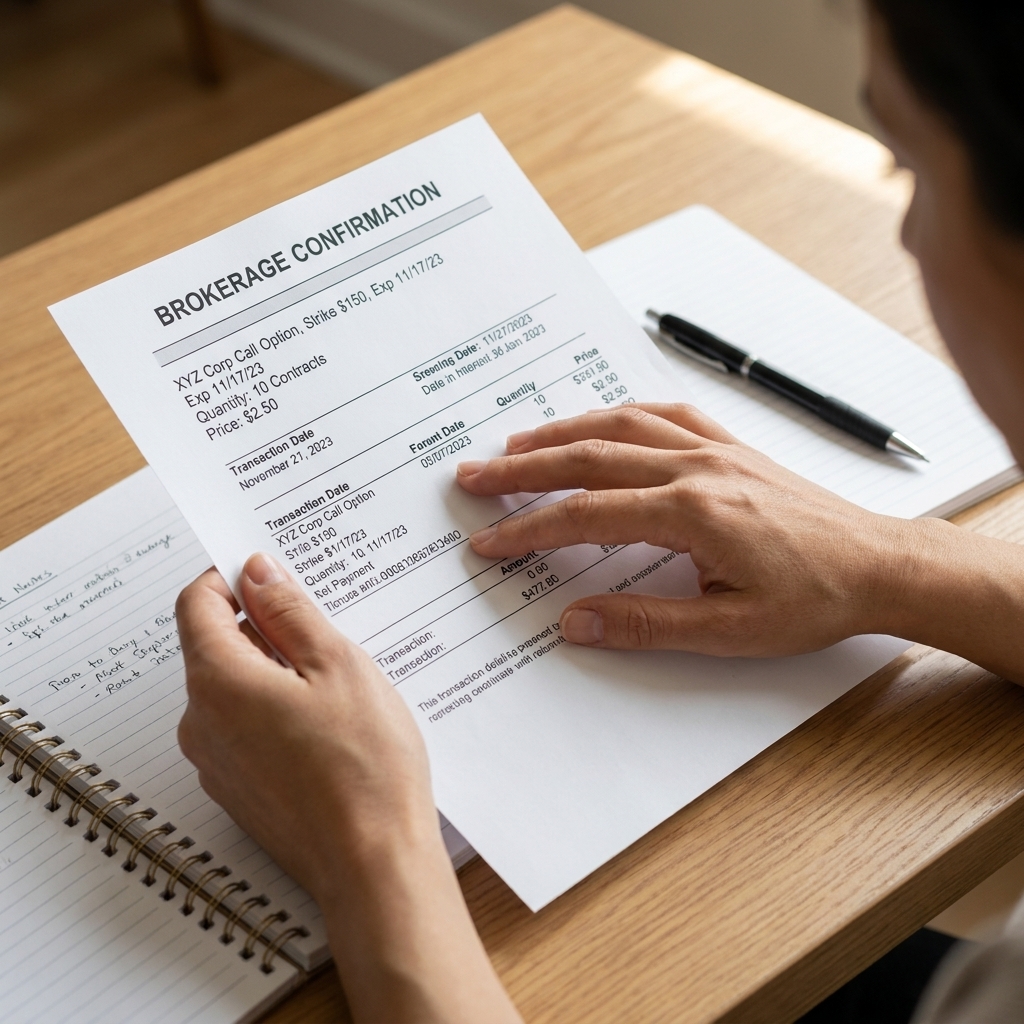
Payoff math at a glance
If you like to see the boundaries clearly, here are the key formulas (ignoring commissions and taxes):
- Max profit: (Strike price − share purchase price) + premium received
- Breakeven: Share purchase price − premium received
- Max loss: Similar to owning the stock, minus the premium. If the stock goes to zero, loss is (share purchase price − premium) per share.
One important nuance: people often say the premium “lowers your cost basis.” Economically, it can raise your breakeven and cushion losses. For taxes and reporting, the premium is often treated differently depending on what happens (expires, closed early, or assigned). More on that below.
When a covered call can make sense
I tend to like covered calls for investors who are clear-eyed about the trade-off: you are getting paid to limit your upside for a while.
Covered calls can be a good fit when:
- You are neutral to mildly bullish on the stock in the short term.
- You would be happy selling at the strike price anyway.
- You want a systematic “portfolio income” habit on positions you already hold.
- The stock is volatile enough that premiums feel meaningful (higher volatility generally means higher premiums).
Common real-world use cases
- Long-term holdings: Generating income while you wait.
- Reducing regret: You set a sell price you can live with, instead of reacting emotionally later.
- Disciplined trimming: Calls can act like a rules-based way to sell into strength.
The risks beginners overlook
Covered calls are often described as “conservative options.” They are lower risk than selling naked calls, but they are not risk-free. Here are the big ones I want you to internalize.
1) You can still lose a lot if the stock drops
The premium is a small buffer, not a helmet. If you sell a $1 premium and the stock drops $10, you are still down $9 per share (before taxes and costs).
2) You can cap your best days
The emotional pain point is real: your stock rockets higher, and your gains stop at the strike price.
This is not a bug. It is the deal you signed up for. The question is whether the premium you collected was worth giving up that upside.
3) Early assignment can happen
In the U.S., many stock options are American-style, meaning they can be exercised before expiration. Early assignment is more common when:
- The option is deep in the money, and
- A dividend is coming up.
The practical detail: early exercise tends to happen when the remaining time value (extrinsic value) of the call is very small, especially if it is smaller than the upcoming dividend and the option is close to expiration. It is not guaranteed, but it is common enough that dividend dates should be on your radar.
4) Taxes can get complicated
Option premiums, short-term gains, and forced sales can create tax outcomes you did not intend, especially in taxable brokerage accounts.
Also, selling calls can affect holding periods and, in certain situations, the qualified status of dividends. In the U.S., this often comes up under the “qualified covered call” rules and related holding-period rules. Outside the U.S., tax treatment can differ significantly. If you are doing covered calls regularly in a taxable account, consider asking a tax professional how your specific trades are treated.
One example of the nuance: in the U.S., if your call expires, the premium is typically treated as a short-term capital gain. If you are assigned, the premium often adjusts your sale proceeds. If you buy to close, your gain or loss is based on the premium received versus what you paid to close.
5) Liquidity matters more than people expect
Wide bid-ask spreads can quietly eat your returns. Generally, covered calls work best on stocks and ETFs with active options markets, where pricing is competitive.
Choosing a strike and expiration
This is where covered calls shift from “concept” to “craft.” There is no perfect setup, but there are sensible starting points.
Strike: what would you sell for?
- At-the-money (ATM): Higher premium, higher chance you get assigned, less upside.
- Out-of-the-money (OTM): Lower premium, lower assignment chance, more upside.
- In-the-money (ITM): Highest premium, very high assignment chance, behaves more like a partial hedge.
Expiration: shorter is not always simpler
Many beginners gravitate toward 30 to 45 days because it balances:
- Frequent opportunities to collect premium
- Less time exposed to sudden stock moves
- Often decent liquidity
Very short expirations can require more monitoring and may increase transaction costs. Very long expirations tie up your upside for longer.

A simple workflow
If you want a simple process you can repeat, here is a beginner-friendly workflow:
- Confirm you own at least 100 shares per contract you plan to sell.
- Decide your time horizon: Many investors start with about 30 days.
- Pick a strike price you would genuinely accept as a sale price.
- Check liquidity: Look for tight bid-ask spreads and decent volume/open interest.
- Enter the trade as “Sell to Open” one call contract per 100 shares.
- Set expectations: You are fine with assignment, or you are not.
- Manage the position: Let it expire, buy to close, or roll (more on that below).
One practical tip: if you would be upset selling the shares at the strike, do not sell that call. That disappointment is information.
Managing the position
Once the call is sold, your job is mostly decision-making. You have a few common paths.
Let it expire
If the option is out of the money near expiration and you are happy keeping the shares, doing nothing is a valid choice. The call typically expires worthless and you keep the premium.
Buy to close
Buying to close means you purchase back the call you sold. People do this when:
- Most of the premium has already decayed and they want to lock in the gain early
- The stock outlook changed and they want their upside back
- An event is coming (earnings, dividend) and they want to reduce assignment risk
A reality check: if the stock rises sharply, buying to close can mean paying a lot, and it often realizes a loss on the call itself. That loss may be offset by gains in the shares.
Roll
Rolling means closing your existing call (buying it back) and opening a new one with a later expiration, a different strike, or both.
People roll when they want to:
- Avoid assignment because they want to keep the shares
- Extend the strategy for more premium
- Adjust the strike after the stock moved
Rolling is not magic. Sometimes you pay more to close than you receive to open, creating a net cost. Other times it is a net credit. Always look at the total math, not just the premium on the new call.
What happens at expiration
If the stock is below the strike
The option typically expires worthless. You keep your shares and the premium.
If the stock is above the strike
By expiration, an in-the-money call will usually be assigned. Your shares are typically sold automatically at the strike, and you keep the premium. This sale can trigger capital gains or losses depending on your share cost and holding period.
Covered calls vs. dividends
I understand why covered calls get marketed as passive income. The premium feels like a paycheck. But it is more accurate to call it income with strings attached.
- Dividends do not cap your upside, but they can be reduced and they come from company cash flows.
- Covered call premiums are compensation for taking on an obligation, and the trade-off is limited upside plus continued downside exposure.
If you treat covered calls like a dividend replacement, you may take more risk than you realize. If you treat them like a tactical tool for specific holdings, they can be a thoughtful addition.
Portfolio fit
As a former strategy consultant, I like to start with the “job to be done.” What job do you want this strategy to do?
- Stabilize behavior: Create a sell discipline and reduce emotional trading.
- Boost cash flow: Generate periodic premiums on positions you are comfortable holding.
- Improve your breakeven: Premiums can offset some downside over time, although they do not eliminate risk, and the tax accounting may not match the mental model.
Covered calls tend to fit best when used on a small set of positions you understand, rather than your entire portfolio. Many investors also use them on broad-market ETFs, where single-stock blowups are less likely.
Beginner mistakes to avoid
- Selling calls on a stock you would hate to lose: If assignment would wreck your plan, rethink the trade.
- Chasing premium on ultra-volatile names: High premium often reflects high risk.
- Ignoring earnings dates: Earnings can cause large price moves that change the assignment odds overnight.
- Overcommitting shares: Do not sell more calls than your share count covers.
- Forgetting taxes and fees: Small frictions add up, especially with frequent trading.

Quick FAQ
Do I need a lot of money to do covered calls?
You generally need at least enough to own 100 shares of the stock (per contract). That is why covered calls are easier on lower-priced stocks or ETFs, and harder on very expensive shares.
Can I lose more than I invested?
With a true covered call (owning the shares and selling one call per 100 shares), your primary risk is the stock falling. You can lose a large portion of the stock’s value, but the call itself does not create unlimited loss the way an uncovered call can.
Is a covered call bullish or bearish?
It is typically neutral to mildly bullish. You can profit if the stock stays flat, rises a bit, or even drops slightly (depending on the premium). You underperform a simple buy-and-hold if the stock surges well above the strike.
What is the “best” covered call strategy?
The best one is consistent with your goals: a strike you would accept, an expiration you can manage, and a stock you would be comfortable owning through normal volatility.
A practical way to start
If you are curious but cautious, start small and make it boring:
- Choose one liquid stock or ETF you already own and plan to hold.
- Sell a single call contract against 100 shares.
- Pick a strike where you would be content selling.
- Use an expiration you can pay attention to, like about a month out.
Then track the outcome like a case study. Did you feel calm, or did it keep you up at night? The emotional data matters as much as the financial result.
Important: This article is for education, not personal investment advice. Options involve risk and are not suitable for everyone. If you want help aligning strategies with your goals, tax situation, and time horizon, consider talking to a licensed financial professional.