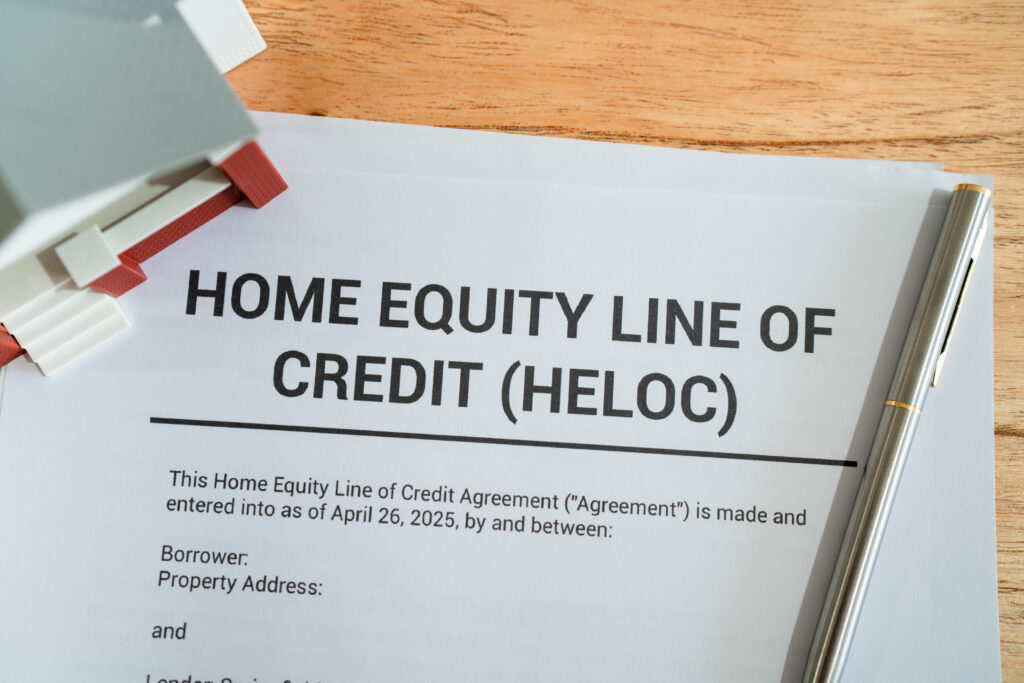
If you already have a HELOC and you are watching your variable rate bounce around, you are not alone. I grew up around a family business where a single rate change could turn a calm month into a sleepless one. The question I hear from homeowners today is a modern version of that same anxiety: can I keep the flexibility of my HELOC, but lock part of what I already borrowed into a fixed rate?
In many cases, yes. Some lenders offer a fixed-rate lock or HELOC rate conversion feature that lets you take a chunk of your outstanding balance and turn it into a fixed-rate segment, while the rest of the line stays open and variable. But the details matter: how much you can lock, what happens to the unused line, how repayment works, what fees can show up, and whether the “fixed” rate is actually better than what you have today.

Quick answer
A HELOC is typically a revolving line with a variable interest rate. A fixed-rate lock (also called a conversion option) is a feature offered by some lenders that may allow you to:
- Select part of your current HELOC balance
- Convert it into a fixed-rate sub-account with a defined repayment schedule
- Keep the remaining line open for future borrowing, usually still at a variable rate
Not all lenders offer this. Even when they do, they set rules around minimum amounts, number of fixed segments, term options, how payment is applied, and fees.
Meet one borrower
Let’s use one borrower throughout so this feels concrete.
Maya has:
- A $100,000 HELOC limit
- A current outstanding balance of $40,000 (used for a kitchen renovation)
- A remaining available credit of $60,000
- A variable rate that has been climbing, making her monthly payment unpredictable
Maya likes the flexibility of the line because she may do more work on the house next year. But she wants to reduce her interest rate risk on at least part of what she already borrowed.
How to check if you can convert
The fastest way to find out is to look for language like fixed-rate advance, balance conversion, rate lock, or fixed-rate option in your HELOC agreement and fee schedule. If you do not see it, call your lender and ask whether your specific HELOC product supports fixed-rate segments and what the rules are.
I also recommend asking for the program disclosure in writing. The big differences between lenders tend to live in the fine print.
How much can you lock
This is lender-specific, but conversion programs often work like this:
- Most lenders let you lock only what you have already borrowed, not unused credit. In Maya’s case, that is up to $40,000. (Some lenders have HELOC products that let you choose fixed or variable at the time of a new draw, so it is worth asking.)
- There is often a minimum lock amount, commonly $5,000 to $10,000 per segment.
- There may be limits on how much you can convert, such as converting only a portion of the balance or requiring some variable portion to remain.
- You may be limited in how many fixed segments you can create, such as 1 to 3 fixed segments at a time.
Example: If Maya’s lender allows up to three fixed segments and requires a $10,000 minimum per segment, she could lock $30,000 into a fixed rate and leave $10,000 variable. Or she could lock the full $40,000 if her lender allows converting 100% of the outstanding balance.

What happens to the unused line
Often, your HELOC still functions like a HELOC. The fixed portion becomes its own mini-loan inside the account, and the remaining line stays open.
Here is what that can mean in practice:
- Your credit limit may stay the same (Maya still has a $100,000 limit).
- Your available credit is still driven by what you owe, including any fixed segment. If Maya locks $30,000 and keeps $10,000 variable, she still owes $40,000 total and still has $60,000 available to borrow.
- Some lenders restrict availability while a fixed segment is outstanding. In other words, a converted portion may not be re-advanceable until you pay it down, or new draws may be temporarily paused while a conversion is processing.
Bottom line: ask whether the converted portion still counts as revolving credit for availability purposes, or whether it acts more like a one-way move into installment debt until it is paid off.
How the fixed rate is set
With most conversion features, the fixed APR is set when you request the conversion, based on your lender’s fixed-rate menu that day (and the term you pick). Some lenders provide a short window to accept the quoted rate, and some treat it as effective immediately once processed.
One important guardrail: converting does not guarantee a lower rate. A fixed segment can be higher than your current variable rate in the moment, especially if markets expect rates to fall. The tradeoff you are buying is payment stability.
Also check whether your HELOC has rate caps or floors on the variable side (periodic and lifetime caps). Those caps do not eliminate rate risk, but they do change the worst-case scenario you are trying to manage.
How the locked portion is repaid
This is where people are often pleasantly surprised: a conversion typically sets up a predictable installment payment for that portion. The flip side is that it can raise your required monthly payment compared with interest-only.
Common repayment structures
- Amortizing payments: You pay principal and interest on the fixed segment over a selected term (for example, 5, 10, or 15 years).
- Separate payment streams: You may have one required payment for the fixed segment plus another required payment for the remaining variable balance.
- Draw period vs repayment period rules: During the draw period, some HELOCs allow interest-only on the variable portion while the fixed segment requires principal and interest. Other lenders require principal and interest on both.
Maya’s example: She locks $30,000 into a 10-year fixed segment. That $30,000 now behaves like an installment loan with a stable monthly payment. Her remaining $10,000 variable balance may still be interest-only (depending on her HELOC terms), and any future draws may be variable unless she converts again.
Simple illustration: A $30,000 fixed segment on a 10-year amortizing schedule will have a set monthly principal-and-interest payment. Your exact payment depends on the APR and your lender’s terms, but the key benefit is that it stops changing every time the variable rate moves.
Where new draws go
Many lenders route new draws to the variable portion by default, then let you convert that new balance later. Others let you choose variable or fixed at the time of draw, or they offer a “fixed-rate advance” option for new money.
If future borrowing is part of your plan, ask your lender: When I take a new draw, can I choose fixed right away, or does it start variable?
Fees and costs
Some lenders offer conversions with minimal friction. Others price them like a feature. Before you lock anything, ask for a clear list of potential costs and how they show up.
One-time fees per conversion
- Conversion or transaction fee: Some lenders charge a flat fee (for example, $50 to $250) each time you create a fixed segment. Others charge more, or charge nothing.
Costs baked into the rate
- Rate add-on: Instead of charging a fee, some lenders build the cost into the fixed APR, meaning the fixed rate may be higher than a standalone home equity loan rate from the same lender.
Early payoff rules
- Early payoff fee or interest recapture: Some lenders charge a penalty if you pay off a fixed segment early, while others allow early payoff with no penalty. This is highly lender-dependent.
Also pay attention to the original HELOC terms. Some HELOCs have annual fees, inactivity fees, or closing cost reimbursement clauses if you close the line early.
Conversion vs a home equity loan
If your lender does not offer conversions, or if their conversion terms are pricey, the alternative is a separate closed-end home equity loan. This is the classic choice covered in the broader “HELOC vs Home Equity Loan” conversation, but here we are applying it after you already have a HELOC.
Option A: Convert part of your HELOC
- Best for: Homeowners who want to keep the line open for future draws but want more payment stability on money already borrowed.
- Structure: One HELOC account with one or more fixed-rate segments inside it.
- Convenience: Often faster and lighter paperwork than a brand-new loan.
- Potential downside: Fixed APR might be higher than a separate home equity loan, and fees can add up if you do multiple conversions. Also, some lenders limit re-borrowing while a fixed segment is outstanding.
Option B: Add a separate home equity loan
- Best for: Homeowners who want a clean, fully amortizing fixed loan and do not need to re-borrow that same money repeatedly.
- Structure: You keep your HELOC (open) and add a new fixed-rate loan, or you refinance the HELOC balance into the home equity loan and potentially close the HELOC.
- Potential upside: Rates and terms can be more competitive, and the payment is straightforward.
- Potential downside: New closing costs may apply, underwriting is typically more involved, and you are juggling two products.
Maya’s decision point: If she is done borrowing and wants certainty, a separate home equity loan to pay off the HELOC balance can be cleaner. If she expects to borrow more next year, a fixed-rate conversion can reduce risk without giving up flexibility.

What to ask your lender
I encourage borrowers to get answers to these in writing, ideally in a fee schedule or program disclosure.
- Do you offer a fixed-rate conversion option on my HELOC product?
- What is the minimum and maximum amount I can convert?
- How many fixed segments can I have at once?
- What terms are available for the fixed segment?
- Is the fixed segment fully amortizing, or interest-only?
- How is the fixed APR set, and how long is the quote valid?
- What fees apply per conversion, and are there early payoff fees?
- Does converting restrict new draws or reduce re-advanceable credit while the fixed segment is open?
- When I take a new draw, can I choose fixed at the time of draw?
- If I sell my home or refinance, what happens to the fixed segment?
- Is there an annual fee on the HELOC even if most of my balance is fixed?
When a partial lock makes sense
A partial fixed-rate lock tends to be a good fit when:
- You are worried about rates rising and you want to cap exposure on a meaningful chunk of your balance.
- You still want revolving access to funds for future projects, emergency liquidity, or irregular expenses.
- You borrowed for a long-lived improvement (like a renovation) and want a stable payoff path.
- You can handle higher required payments if the fixed segment is amortizing (principal and interest) instead of interest-only.
When a home equity loan may be better
A standalone fixed home equity loan is often a better move when:
- You are finished drawing and just want the cheapest, cleanest fixed payoff structure.
- Your lender’s conversion pricing is uncompetitive versus market home equity loan rates.
- Conversion fees or limits are restrictive, especially if you would need multiple segments.
- You want a single fixed payment without variable balance complexity.
FAQ
Does locking a portion change my HELOC’s rate on the rest?
No. The variable portion generally continues to float based on your HELOC’s rate formula (often an index plus a margin). Only the converted segment is fixed.
Can I lock the unused part of my HELOC line?
In most cases, no. Many lenders let you convert amounts you have already borrowed. Unused credit typically remains available to draw at the variable rate, unless your lender offers fixed-rate advances for new draws.
If I pay down the HELOC, does it pay the fixed segment or the variable balance first?
It depends on lender rules and how your payment is applied. Some lenders allocate payments by segment with separate required payments. Others apply extra principal in a specific order. Ask for the payment application policy so you are not surprised.
Is a fixed-rate conversion the same as refinancing?
Not exactly. A conversion is usually an internal feature of your existing HELOC. Refinancing typically means replacing debt with a new loan, often with new underwriting and closing costs.
Is HELOC interest tax deductible after a conversion?
Tax rules can be specific to your situation. In general, interest deductibility depends on current IRS rules and how you used the proceeds (for example, qualifying home improvements versus other uses). If this matters to your decision, it is worth confirming with a qualified tax professional.
Bottom line
You often can lock part of a HELOC balance at a fixed rate if your lender offers a conversion feature. The locked portion typically becomes an installment-style segment with a fixed rate and a defined repayment schedule, while the remaining line may stay open.
For someone like Maya, a partial lock can be a practical middle ground: less rate stress today, without giving up flexibility tomorrow. Just make sure you understand the conversion limits, whether it affects your ability to re-borrow, how the fixed APR is set, how payments are applied, and any per-conversion or early payoff fees before you commit.